Showing posts with label Nature. Show all posts

Sunday, 12 March 2017

Lovejoy and the hell-ocentric worldview

Arthur O. Lovejoy's The Great Chain of Being (based on lectures held in 1933) tells the story of an influential idea in western thought, that of the 'Chain of Being', from Plato to Schelling. I read it to familiarize myself a bit more with pre-modern ideas of nature, prior to the establishment of the nature-culture distinction and the associated belief in the superiority of humankind as separate from and standing above nature (beliefs that, as Philippe Descola and others have pointed out, are both parochially Western and historically recent).

According to the idea of the chain of being, humankind was not separated from nature, but part of it, just one rung among others on the infinite ladder (the scala naturae) reaching up to God’s perfection. As Lovejoy points out, a logical corollary of this idea was that humankind was only infinitesimally separated from other rungs. Hence there was a “consanguinity of man and the animals” (pp. 195-198, references here and below to the 2001 Harvard University Press edition).

Scala naturae, Didacus Valades (1579)
The idea, which made its first organized appearance in Neoplatonism, is defined by three principles: those of plenitude, continuity and gradation. These principles say that the world must contain all possible kinds of being (even imperfect ones) and that these must be linked in a chain of continuity and graded according to their degree of perfection. When these principles came together in Neoplatonism, the result was "the conception of the universe as a ‘Great Chain of Being’, composed of an immense... number of links ranging in hierarchical order from the meagerest kind of existents... through ‘every possible’ grade up to the ens perfectissimum” (p. 59)

One of the things I found interesting in the book was how Lovejoy conceptualized the transition from medieval to modern worldviews. He points out that the idea of the chain of being, although forming an important undercurrent in medieval thought, was prevented from becoming dominant during the middle ages since it faced competition from the anti-rationalism of scholastics like Duns Scotus or William of Ockham who saw the inscrutable will of God as the sole ground of all value distinctions. What defines the arrival of modernity isn't the triumphant rise of what most of us think of as 'modern science' so much as the liberation of the idea of the chain of being from its old scholastic competitor. Freed from this competitor, the idea of the chain of being blossoms to its full splendour in early modernity, above all in the 18th century when, for example, it becomes a dominant motif in Alexander Pope's poetry and forms the philosophical core of Leibnitz' "optimism".

In telling this story, Lovejoy makes an interesting digression on medieval cosmology prior to the heliocentric worldview. The aim of the digression is to show that the 'Copernican revolution' wasn't very important in establishing the modern worldview. It certainly didn't mean a shift from a worldview in which humankind was central to creation to one in which it wasn't. “It is an error", he points out, "to suppose that the medieval world was a small affair, in which the earth bulked relatively large” (p. 99). The Ptolemaic system thus saw the earth as a mere dot compared with the heavens, and so did Maimonides.
It has been shown that the distance between the centre of the earth and the summit of the sphere of Saturn is a journey of about eight thousand seven hundred years of 365 days, assuming that one walked forty leagues a day [i.e., the distance, in round numbers, is 125 million miles]... Consider this vast and terrifying distance... Consider, hten, how immense is the size of these bodies, and how numerous they are. And if earth is thus no bigger than a point relatively to the sphere of the fixed stars, what must be the ratio of the human species to the created universe as a whole? And how then can any of us think that these things exist for his sake, and that they are meant to serve his uses? (Maimonides, quoted on p. 100)
In the following striking passage, Lovejoy then points out that the tendency of the geocentric system was the very opposite of giving man a high sense of his own importance.
For the centre of the world was not a position of honor; it was rather the place farthest removed from the Empyrean, the bottom of creation, to which its dregs and baser elements sank. The actual centre, indeed, was Hell; in the spatial sense the medieval world was literally diabolocentric. (p. 101f). 
To paraphrase somewhat, the medieval worldview prior to the heliocentric order was hello-centric.

L'image du monde by Gautier de Metz (1464), showing Hell in the centre of a universe made of concentric circles.
This worldview lingered on in Montaigne, who described humanity's dwelling-place as "the filth and mire of the world, the worst, lowest, most lifeless part of the universe, the bottom story of the house" (quoted on p. 102) and John Wilkins who mentions as an argument against Copernicus that the earth because of its vileness "must be situated in the centre, which is the worst place, and at the greatest distance from those purer incorruptible bodies, the heavens" (quoted on p. 102). As Lovejoy concludes, "the geocentric cosmography served rather for man's humiliation than for his exaltation" (p. 102).

The Copernican hypothesis, then, wasn't important in challenging notions of humankind's centrality. More important was the growing sense that the universe might be acentric, associated with the assumption that the stars might be suns like our own, that these might be encircled by planets inhabited by rational beings like us, and so on - all ideas associated with the Chain of Being and the idea of boundless plenitude.

In Lovejoy's portrayal of early modern thought, then, there are few traces of any ideas of human superiority over nature or human centrality in the universe, and interestingly he argues that the tendency to assign a peripheral role to humankind increases in early modernity, thanks to the dominant influence of the idea of the Chain of Being.

Before ending, it is of course relevant to point out that another part of his argument is that this idea starts to wither away towards the end of the 18th century, when it collides with the idea of progress. To some extent it adapts by opening up for temporality in the realization of plenitude. The program of nature is now seen as carried out only gradually, in a slow ascent up the “ladder”. The idea of timeless fullness is replaced by that of unending progress. With this, a new era of thought begins on which the book hardly touches at all.


Sunday, 23 October 2016

Lukács's defence of History and Class Consciousness

Following the attacks by Abram Deborin, Laszlo Rudas and others on his History and Class Consciousness, Georg Lukács penned an angry response sometime in 1925 or 1926. The unfinished manuscript was never published and remained unknown for a long time (Lukács himself apparently never mentioned its existence), until it was discovered in the archive of the Comintern and the Central Party Archive of the Communist Party of the Soviet Union in Moscow. It was published for the first time in Hungarian and German in 1996. The English version, titled A Defence of History and Class Consciousness: Tailism and the Dialectic, was published by Verso in 2000. Below I'll simply refer to it as the "Defence".

History and Class Consciousnessone went on to become one of the foundational, classical texts of so-called Western Marxism, but Lukács himself repudiated it in the mid-1920s as part of kowtowing to party orthodoxy. This kowtowing was no doubt the reason the manuscript for the "Defense" was left unfinished. Aoart from the "Defense", few texts exist where Lukács even mentions History and Class Consciousness. There is the preface he wrote for the book in 1967, but this preface is little but an extensively argued rejection of his own early work, a text where Lukács goes to great lengths to castigate himself for a series of errors he believes he committed in it, including idealism, revolutionary messianism, misunderstanding the concept of alienation and neglecting the dialectics of nature (Lukács 1971a). In contrast to this preface, the "Defence" is truly a defence of History and Class Consciousness

What is there, then, of interest in the "Defense"? A noteworthy point concerns the importance of praxis - which Lukács discusses in terms of "moment" and "decision" and which he links to a criticism of the fatalist reliance on "process" (Zizek has a striking interpretation of this in his afteword, which, however, seems to overemphasize the decisionist aspect of Lukács's thought). Here's Lukács's definition of the "moment": 
What is a ‘moment’? A situation whose duration may be longer or shorter, but which is distinguished from the process that leads up to it in that it forces together the essential tendencies of that process, and demands that a decision be taken (Lukács 2000: 55)
This, however, is not pure decisionism, because what matters in such moments is class consciousness (ibid. 56). Another long discussion in the book concerns precisely how class consciousness comes into being. As in History and Class Consciousness, he rejects the "spontaneist" position associated with Rosa Luxemburg. The masses can't be trusted to develop this consciousness by itself. Instead, the party becomes decisive, as the place where class consciousness realizes itself. It's the party that "imputes" the consciousness to the workers (ibid. 71ff).

By far the most interesting part of the book concerns the dialectic of nature. In History and Class Consciousness the general thrust of Lukács's argument was to argue that dialectics essentially involved a relation between subject and object, and thus to deny - against Engels - that dialectics could be extended to the subjectless realm of nature. Spotting the weakness of Lukács's position, his critics accused him of lapsing into "dualism" by separating society from nature. Even today, it's popular among commentators to point to the problems and inconsistencies that arise in Lukács's work because of his refusal to extend dialectic to nature. From a variety of angles, commentators like Vogel (1996), Feenberg (2014), Jay (1984: 116), Foster and Loftus have focused on the following contradiction. If dialectics must halt before nature, doesn't this imply that nature is a realm where non-dialectical methods - e.g. those associated with positivism - are legitimate? But if such methods are legitimate, then how can they also represent an instance of reifying, bourgeois thought, as Lukács claims?

How serious are these accusations? In his 1967 preface, Lukács readily admits to the error of having viewed "Marxism exclusively as a theory of society, as social philosophy, and hence to ignore or repudiate it as a theory of nature" in History and Class Consciousness (Lukács 1971a). This admission is hardly surprising, considering the generally dismissive stance Lukács takes in this preface to his book. One has the feeling, however, that his admission is a bit too facile, that it simplifies matters too much. A more complex and interesting argument is set up in the "Defense" where Lukács puts up much more of a fight to defend his statements in History and Class Consciousness.  

In fact, the position expressed in History and Class Consciousness isn't so simple as Lukács pretends in his preface. The argument that the dialectic doesn't apply to nature is thus modified firstly by the repeted insistence that nature is a "social category" - a claim that suggests that our knowledge of nature is decisively shaped by the historical dialectic shaping society. Secondly, it is also modified by a rather odd, isolated passage where Lukács acknowledges the possibility of an objective dialectic operating in nature independently of humans while stressing that the absence of human consciousness in this dialectics means that it is different from the social dialectics and must be studied in a different way (ibid. 1971b: 207). This is odd since it appears to contradict his emphasis elsewhere on the subject-object relation as central to dialectics.

Turning to the "Defence", Lukács presents a number of arguments related to nature. Firstly, he clarifies that he in History and Class Consciousness had talked “only of knowledge of nature and not nature itself” (ibid. 2000: 97). That is the sense in which nature is a social category. It simply means that there is no socially unmediated relationship of humans to nature. This, he argues, follows from Marx’s thesis that our consciousness (which of course includes our consciousness of nature) is determined by our social being (ibid. 100). That society mediates our knowledge of nature, however, doesn't mean that one has to deny the objective, independent existence of nature. “Self-evidently nature and its laws existed before society” – but from that doesn’t follow that “nature would be knowable without the mediation of these new social dialectical forms” (ibid. 102). He repeats the acknowledgement in History and Class Consciousness that there is an objective dialectics in nature that is independent of humans, but insists that humans are still needed “for thinking the dialectic, for dialectic as knowledge” (ibid. 107). On the whole, then, this first argument amounts to a forceful assertion of the priority of a subject-centred dialectics, not only in the realm of society but also in regard to our knowledge of nature.

The second argument is a continuation of this. Lukács defends his decision in History and Class Consciousness to characterize “as the decisive dialectical categories not transformation of quantity into quality, etc., but rather interaction of subject of object” (ibid. 112). This decison implied a rejection of Engels's material dialectics, which had stressed objective laws such as the transformation quantity and quality rather than praxis. To Lukacs, however, the subject-object relation is central because of the historical situation in which the proletariat rises to transform society. Overlooking this need for transformation leads to eternalizing the categories as in bourgeois immediacy, making the concepts lose all dialectic functionality.
‘Dialectical’ categories that have been severed from this connection can even be used by bourgeois researchers; it is not inconceivable that they might, for example, be able to work with the transformation of quantity into quality. The category becomes properly dialectical only in the context of the dialectical totality (ibid. 113)
This, of course, sounds very much like a defense of the general overall conception of dialectics in History and Class Consciousness. But how about the objection that Lukács in that book fails to clarify whether natural science has a legitimate place or not? Is it compatible with a dialectical approach?

To tackle this question, Lukács introduces an important third argument. While natural science - like all consciousness - is determined by society, it “does indeed adopt a special place in the history of human knowledge” (ibid. 113). It would thus be “false relativism” to dismiss it as a merely bourgeois form of thinking or to treat it “in the same way as the knowledge of nature of past epochs” (ibid. 114). While it was born with capitalism, there is a “factual obstacle” to concretizing how natural science is determined by society. The transformation of science only takes place gradually as the effect of the revolution of the material basis and the course of this transformation cannot be known in advance. This means that even socialism must use natural science in its bourgeois form for the time being since a new science has yet to emerge (ibid. 117). In other words, there mere fact that all knowledge is socially determined doesn't mean that we can transcend the horizon of that knowledge and dismiss it as "relative" or as belonging to a past era that has been overcome by the events of 1917. To jump immediately to a more "dialectical" science would be an illegitimate shortcut.    

The question remains, however, why the natural sciences in particular are so hard to transcend compared to, say, the social sciences. Why is it more legitimate to dismiss the use of non-dialectical methods in the latter? Lukács doesn't provide any clear answer to this question in the "Defence", but a reasonable answer would be that our self-awareness directly affects society in a way that isn't true of nature. We don't really need to transcend the horizon of social science to realize that society can't be fully understood without taking praxis or subjectivity into consideration. The fact that non-dialectical methods can be cogently criticized in an immanent fashion within the field of social science means that there is no need to resort to what Lukács calls "false relativism", e.g. dismissing such methods as "bourgeois" or belonging to a bygone era.

As mentioned, Lukács doesn't spell out this answer explicitly. He does, howeveer, add a brief, fourth argument which suggests that this is indeed how he would have answered it. In the realm of society, our palpable experience of frequent change and of the role of human praxis make it easy for us to realize the limits of trying to understand society through ahistorical, non-dialectical categories. In nature, by contrast, it's possible that certain things are eternal or only change so slowly that they may never be known dialectically:
To what extent all knowledge of nature can ever be transformed into historical knowledge, that is to say, whether there are material actualities in nature that never change their structure, or only over such large periods of time that they do not feature as changes for human knowledge, cannot be raised here (ibid. 118)
This passage suggests that the non-dialectical traits of existing natural science may have to be abandoned one day, provided that we come to the realization that nature is more changing and less ahistorical than we thought. However, Lukács leaves it open whether or not this will ever happen.

Looking back, Lukacs's presents four arguments that can be summarized as follows:
  1. Our knowledge of nature is never wholly free of social determinations - implying that even an objectivistic framework for studying nature (e.g. an objectivistic dialectics of nature or natural sciences of the positivistic type) will always be embedded in a social dialectics.
  2. A genuinely dialectical method involves a relation between subject and object rather than being merely objective or contemplative. Even if a dialectics of nature is possible, it can't be studied as if it were merely objective. An objectivistic dialectics wouldn't really be different from ordinary, "bourgeois" science.
  3. But even if existing and seemingly non-dialectical natural sciences are in reality embedded in a social dialectics, they can't yet be simply replaced by any more overtly dialectical method for studying nature, although this might be possible in the future. This is because we cannot anticipate the future science that may result from revolutionizing the material base. Despite existing forms of natural science having their social roots in capitalism, we are stuck with them for the time being.
  4. However, to the extent that nature and its lawlike regularities are subject to change, some form of objective dialectical movement may be taking place in nature. This implies that the methods of non-dialectical natural science will ultimately prove to be insufficient also in the realm of nature. However, we don’t know to what extent such change is happening.
Taken together these arguments do form a kind of defense for, and clarification of, the position Lukács adopts in History and Class Conssciousness. While acknowledging that nature may have its own dialectical laws and that our knowledge of nature is socially mediated, he nevertheless refuses to impose dialectical methods on the study of nature. At least for the time being, the existing non-dialectical methods of natural science are legitimate in relation to nature. At the same time, he holds out the prospect of a different natural science in the future, one that will be self-aware of its own social determination. Before that day comes it won't be possible to discern what in science is tied to bourgeois social formations and what is not. This is admittedly a complex and rather difficult position to defend. But regardless of its strength or weakness, it is much more interesting than the flat capitulation offered in the 1967 preface.


Post-script on Foster

Before ending, I'd like to add a comment on John Bellamy Foster. As I've discussed already (here and here), Foster bases a great part of his criticism of Western Marxism on its restriction of dialectics to the realm of society and praxis. By rejecting Engels's dialectics of nature, he argues, Lukács and other Western Marxists handed over the study of nature to positivism. In his "Defense", however, Lukács anticipates many of the moves Foster makes in order to reconstruct a dialectics of nature. On the one hand, Lukács admits of the possibility of an objective dialectics operating in nature independently of humans (as Foster himself points out). On the other, he also - like Foster - stresses that the act of knowing nature must always involve dialectics.

Considering these similarities, why does Foster criticize Lukács? An important part of the reason is obviously his dissatisfaction with the fact that Lukács, at least for the time being, admits of the legitimacy of an "undialectical" natural science as a tool for studying nature. Another part of the reason is probably that Lukács never really clarifies what he means by the objective dialectics operating in nature. Foster, by contrast, puts considerable effort into developing the idea of such a dialectics and on the basis of that tries to assert a "unity of method" for both society and nature.

In Lukács's "Defense", however, we find a series of objections to precisely the kind of project Foster seems to engage in. As we have seen, Lukács ultimately asserts the primacy of subject-object dialectics as the basis for studying both society and nature. Foster, by contrast, is only partially relying on a subject-object dialectics (e.g. when he argues that capitalism creates a metabolic rift in the relation to nature). In the main, his project is to develop a "subjectless" dialectics operating in nature itself inspired by Epicurus' atomistics and Darwin's theory of evolution.

Foster's problem is that to the extent that he emphasizes the former type of dialectics, his position is not all that different from Lukács and Western Marxism and his harsh criticism of them therefore seems unfair. To the extent, however, that he instead emphasizes the latter type of dialectics, he ends up in a position where he will be vulnerable to Lukács's criticism. Firstly, his attempt to sketch a dialectics of nature on the model of Epicurus or Darwin seems to overlook that nature is a social category. Secondly, since this type of dialectics neglects the element of praxis, he seems vulnerable to the criticism that it will be merely contemplative and therefore easily reabsorbed in bourgeois research. Thirdly, such an objectivistic dialectics of nature would have to compete with the existing natural sciences. Its aim seems to be to do precisely what Lukács says is impossible: namely to anticipate the transformed natural science of the future and, on that basis, replace the existing natural sciences. The only alternative to actually competing with them would be to argue that natural science itself has already developed in a way that has made it less positivistic and more dialectical. To some extent, this is precisely what Foster is trying to argue by referring to Darwin and to contemporary biologists (such as Levins, Levontin and Gould) who are sympathetic to Engels's idea of a materialist dialectics. Against this, however, one might object that the overwhelming majority of scientific studies are still more positivistic than dialectical.

If Lukács's arguments hold, Foster is in a fix. Either he has to adopt a subject-object dialectics similar to the Western Marxists he set out to criticize, or else he has to mimick the natural sciences and compete with them on their terms by developing an objectivistic dialectics of nature. I don't really wish to evaluate here to what extent Lukács's claims can be upheld. It should be clear, however, that he is far from defenseless against the kind of criticism that Foster has directed against him. His position may be difficult to defend, but so is Foster's.


References

Feenberg, Andrew (2014) The Philosophy of Praxis: Marx, Lukács and the Frankfurt School, London: Verso.

Jay, Martin (1984) Marxism and Totality: The Adventures of a Concept from Lukács to Habermas, Berkeley: University of California Press.

Lukács, Georg (1971a) “Preface to the new edition (1967)”, pp ix – xivii, in History and Class Consciousness: Studies in Marxist Dialectics, London: Merlin Press.

Lukács, Georg (1971b) History and Class Consciousness: Studies in Marxist Dialectics, London: Merlin Press.

Lukács, Georg (2000) A Defence of History and Class Consciousness: Tailism and the Dialectic, London: Verso.

Vogel, Steven (1996) Against Nature: The Concept of Nature in Critical Theory, Albany: State University of New York Press.


Monday, 17 October 2016

Labour and scarcity: Ricardo's caveat

Ricardo states something interesting on the first pages of his Principles of Political Economy and Taxation. He states that although scarcity contributes to exchange value he will exclude it from his analysis. That means that his labour theory of value, as expounded in the rest of the book, only concerns situations without scarcity.
Possessing utility, commodities derive their exchangeable value from two sources: from their scarcity, and from the quantity of labor required to obtain them.
    There are some commodities, the value of which is determined by their scarcity alone. No labor can increase the quantity of such goods, and therefore their value cannot be lowered by an increased supply. Some rare statues and pictures, scarce books and coins, wines of a peculiar quality, which can be made only from grapes grown on a particular soil, of which there is a very limited quantity, are of this description. Their value is wholly independent of the quantity of labor originally necessary to produce them, and varies with the varying wealth and inclinations of those who are desirous to possess them.
    These commodities, however, form a very small part of the mass of commodities daily exchanged in the market....
    In speaking, then, of commodities, of their exchangeable value... we mean always such commodities only as can be increased in quantity by the exertion of human industry (Ricardo 1996: 18)
This passage strikes me as very suggestive in regard to the question of the relation between nature and capitalism. After all, nature is finite. Many natural resources are scarce. The way nature is priced within capitalism doesn't reflect labour, but - Ricardo seems to suggest - is better estimated through a supply and demand framework where supply is inelastic. This admission clearly makes the labour theory of value easier to defend, since many common objections to it seem to concern situations that involve scarcity.

We should note, by the way, that here "scarcity" doesn't mean scarcity in general, or scarcity in relation to human needs. It means scarcity in relation to economic demand, meaning a situation where the supply of a certain commodity cannot be easily increased to match the demand of people who would afford to buy it. Contrary to the common viewpoint that the "supply and demand" framework in economics is incompatible with the labour theory of value, Ricardo here states that this theory applies best to situations where supply and demand are perfectly elastic, i.e. free to adapt flexibly to each other. In other words, it applies precisely to the kind of idealized, unrealistic markets used in textbook economics. Just try a thought-experiment: if it had been possible to produce oil freely, the price would certainly be far lower than today, possibly reflecting the price of the labour needed to produce it. It seems clear, then, that a lot of problems with the labour theory of value might disappear if we recall Ricardo's caveat that it isn't meant to apply to situations of scarcity.

Despite recognizing the importance of scarcity, Ricardo seems to think that we can legitimately abstract from it if we wish to understand the logic of capital accumulation, since scarce commodities are few and since there can't be any long-term growth in such commodities. Against this, it is easy to argue that scarce commodities are not marginal at all, but form a central part of our economy. Not only nature, but also real estate, money and labour power are examples of commodities with inelastic supply. Scarcity characterizes key commodities - such as oil - that are central to the functioning of capitalism as a whole. Furthermore, we can easily realize the importance of scarcity in the economy if we recall that scarcity includes not only "natural" scarcity but also scarcity that is "socially" created, for instance by monopolies, copyrights, patents, custom barriers and so on. As Immanuel Wallerstein (2004:25) points out, all profitable enterprises are in fact monopolistic or quasi-monopolistic, since profits would evaporate if competitors were perfectly free to imitate successful innovations. From that viewpoint, scarcity is key to understanding capitalism. Far from being something that can be legitimately neglected, the role played by scarcity in the process of capital accumulation is precisely what needs to be better understood.


Marx and scarcity

Marx developed his value law from Ricardo's labour theory of value, but he also introduced important modifications to it, above all the idea of socially necessary labour-time. Does Marx's version of the labour theory of value abstract from scarcity, like Ricardo's, or do his modifications mean that it takes account of scarcity? This question is important to clarify in order to: 1) assess the persuasiveness of Marx's value law, and 2) ascertain to what extent this value law helps us understand the relation between capitalism and nature.

Unlike Ricardo, Marx doesn't - as far as I know - anywhere state clearly that he will abstract from scarcity in his analyses. In fact, it's not easy to find much explicit discussion of scarcity at all in his writings, except in the chapters on ground rent near the end of volume 3 of Capital. As one commentator states: "Marx did not like to write about scarcity. Malthus ruined the question for him" (Moore 2014:92).

The lack of clarity in regard to how he stands in relation to scarcity has, I suspect, led to some confusion around to what extent Marxist analyses are applicable to "nature", "land" or "immaterial" forms of production (I include "immaterial" production in this list since it's a field where the artificial scarcity created by copyright is important).

Is it true that Marx disregards scarcity? To some extent, yes. Take this passage in Volume 1 of Capital where he writes about the means of production that “if... it is not the product of human labour, it transfers no value to the product. It helps to create use-value without contributing to the formation of exchange-value” (Marx 1967a: 204). Marx disregards scarcity here, since it is only in conditions without scarcity that nature creates use-value without contributing to exchange-value.

But in Volume 3 of Capital, he does discuss scarcity. A natural power:
does not enter into the determination of price, so long as the product which it helped to produce suffices to meet the demand. But if in the course of development, a larger output is demanded than that which can be supplied with the help of this natural power... then a new additional element enters into capital... a rise in the price of production takes place. (Marx 1967b: 745)
In order words, the exchange value of commodities that exist in limited supply, such as natural resources, does not reflect the labour needed to produce them.  Commenting on this passage, Paul Burkett points out that it is from scarcity that rent arises, and that the theory of rent solves the problem of how commodities that don’t contain labour can possess exchange-value. Furthermore, he points out that scarcity is a precondition of monopolization and that land rent is a redistribution of surplus-value derived from a monopolized force of nature (Burkett 2014: 74f, 90). Profits derived from scarcity, in other words, represent a redistribution of surplus-value produced elsewhere in the capitalist system. These profits therefore contribute to the capital accumulation only of certain capitalists, not of the capitalist system as a whole. This argument is fine as far as it goes. We can note that it seems to hold both for Ricardian and Marxian economics.

However, Burkett then adds an important argument that suggests that Marx's value law - unlike Ricardo's - does take account of scarcity: "But these conditions, together with their rents, are freely appropriated insofar as their useful effects can otherwise be produced, if at all, only through an additional expenditure of wage-labor time" (ibid. 75). This means that the value law can account at least to a certain extent for rising exchange values, even where those exchange values seem due to scarcity rather than labor. In such situations, “socially necessary labor-time” may still determine prices since the rent reflects the cost of the wage-labor that would be required to produce an additional equivalent unit. Far from excluding scarcity from consideration, Marx’s theory accounts for the higher prices scarcity gives rise to, since more labor is required to produce the commodity the scarcer it gets:
In Marx’s analysis, if a useful natural condition of production becomes increasingly scarce... the average productivity of the labor appropriating or utilizing this natural condition is, by definition, reduced... The values of the commodities produced with the increasingly scarce natural condition will, accordingly, be increased due to the greater amount of social labor time now required to produce the same use values. (ibid. 106)
What enables Marx to account for scarcity is the concept of "socially necessary labour-time". Interestingly, this concept operates with a kind of marginality: the socially necessary labour that according to Marx gives rise to a commodity's value isn't the actual amount of labour expended in manufacturing it, but the labor an imagined competitor would have to be prepared to expend in order to manufacture one more equivalent unit of the commodity (e.g. by prospecting for more of a scarce natural resource or developing an artificial substitute).

The modification that Marx introduces in Ricardo's labour theory of value then - namely that value is the product of abstract labour, reflecting the labor time that is socially necessary to produce the commodity - means that he can drop Ricardo's caveat, at least to some extent. But can he drop it entirely? Perhaps not. Even the concept of "socially necessary labour-time" cannot account for the exchange values obtained in wholly monopolistic situations, where the socially necessary labour of an imagined competitor would be infinite. Against this, one might turn the argument around and argue that it is precisely the excessive amount of "socially necessary labour-time" in situations like this that explains why a monopoly can be maintained at all. Still, the problem remains that some commodities aren't just monopolized but truly unique (e.g. celebrity items or certain pieces of real estate). In the case of unique commodities, prices seem to fluctuate only according to their desirability. The connection with labour time seems lost totally, and we're back in a situation where supply-and-demand works better. The alternative would be to deny that any commodity can be unique by stretching the concept of "equivalence". If we don't wish to take this step, however, the conclusion seems to be that we still need something like Ricardo's caveat in order to make the labor theory of value wholly persuasive. Alternatively, we need to recognize clearly that whenever there is scarcity, exchange values do not reflect value. The "rent" arising from such commodities is not reflective of any surplus-value created by labour, but the result of a redistribution of surplus-value produced elsewhere in the economy.

By way of ending, let me return to the question whether scarcity is important. I've already mentioned the argument that scarcity is marginal from the standpoint of the capital accumulation of the capitalist system as a whole. After all, if profits obtained by scarcity only represent a "rent"-like redistribution of the aggregate surplus value produced in the system, then it seems legitimate to disregard it if we're interested primarily in the fundamental logic of capital accumulation as such. But it seems to me that one can make two objections to this argument.

Firstly, the argument disregards the role of "socially" created scarcity in raising profits overall by creating new rounds of capital accumulation - namely when it is accompanied by rising demand. For instance, when a new innovation is introduced in the market it is usually "scarce" in the sense that competitors don't yet have any equivalent commodity to offer. As mentioned, scarcity isn't a natural, objective property, but exists in relation to demand. If demand rises - for instance through a technological breakthrough that makes new machinery or new consumer goods available on the market - then a situation will result where scarcity is co-produced with and forms an integral part of the boost in capital accumulation.

Secondly, to disregard scarcity seems extremely unhelpful considering that, strictly speaking, no commodities are unaffected by scarcity. All commodities - both material and immaterial - require finite means of production. Neither raw materials nor energy nor labor power exist in infinite supply. If this is so, then scarcity is simply a too central component of how the economy works to be disregarded.


References


Burkett, Paul (2014) Marx and Nature: A Red and Green Perspective, Chicago: Haymarket Books.

Marx, Karl (1967a) Capital, Volume I, New York: International Publishers.

Marx, Karl (1967b) Capital, Volume III, New York: International Publishers.

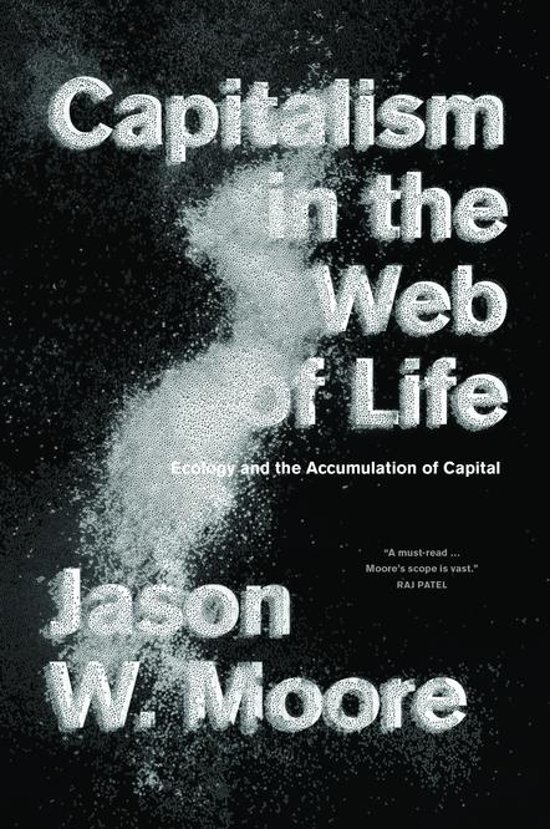
Moore, Jason (2015) Capitalism in the Web of Life: Ecology and the Accumulation of Capital, London: Verso.

Ricardo, David (1996) Principles of Political Economy and Taxation, New York: Prometheus Books

Wallerstein, Immanuel (2004) World-systems Analysis: An Introduction, Durhamn: Duke University Press.

Wednesday, 5 October 2016

John Bellamy Foster: Two materialisms, two kinds of dialectics

In my previous post I pointed to some difficulties with Foster's attempt to extend the notion of dialectics to nature. However, there is a bigger problem with this attempt to which I will now turn. Contrary to his intentions, the attempt reproduces a methodological dualism that runs counter to his aim of a "unity of method". I explain why this is so in the first section below before turning, in the second section, to Foster's charge against Western Marxism that it lost touch with materialism and drifted in an idealist direction. As I discussed in my previous post, Foster claims that the price paid by Western Marxists for rejecting Engels's materialist dialectics was that they ended up in an idealist position and had to relinquish the study of nature to positivism. By way of ending, I suggest that this criticism is unfair and that Western Marxism offers theoretical tools for grasping the relation between nature and capitalism that are more useful than Foster thinks and that may be superior to his own.


Dialectics or monism? (Juan O'Gorman, Monumento funebre al capitalismo industrial)


A dialectics in relation to nature or a dialectics of nature?

Foster wants to demonstrate the possibility of a unity of method in the study of nature and society by showing that a similar dialectical method is applicable in both realms. How well does he succeed in reaching this aim? Broadly speaking, he seems to use two quite different strategies.

The first is to see dialectics as unfolding in the relation between humanity and nature. This strategy is consistent with his emphasis on the "metabolic rift" and with his idea of dialectics as a necessary element of human cognition in relation to nature. It is also consistent with Marx's emphasis that dialectics centrally involves human praxis, taken in a wide sense as including the way labour as a metabolism with nature is organized. Dialectics in this sense could be used to stitch together the two realms of society and nature, as long as the latter isn't viewed as a pristine realm existing independently of human action or human perception. Combined with the fact that capitalism has nowadays engulfed the entire globe, leaving practically no pristine wilderness behind, this argument goes a long way in ensuring the usefulness of dialectics in the study of nature. It is almost, but not quite enough, to achieve methodological unity. The problem for Foster is, firstly, that this sort of dialectics wouldn't be so very different from the "praxis"-centred dialectics of Western Marxism. Dialectics would basically still be seen as a property of human praxis. It's applicability to nature is a by-product of the socialization of nature in the course of the expansion of capitalism. Secondly, the problem remains of how to theorize the wholly non-human nature that existed earlier in history or that still exists out in space still remains.

The other strategy is to try to work out a dialectics of nature as such, showing how nature develops dialectically even without human interference. Foster admits that Marx himself tended to link dialectics primarily to human praxis, but argues that Marx nevertheless acknowledged the possibility of dialectics operating "ontologically" in nature itself. Engels's attempt to put forth a "dialectics of nature" was thus wholly legitimate when viewed from the standpoint of his and Marx's basic philosophical outlook. Foster believes, however, that Engels overemphasized the deterministic and mechanistic aspects of the dialectics of nature. To reconstruct a more openended dialectics of nature, Foster thus turns to Epicurus' atomistics and Darwin's theory of evolution, which he argues were bigger influences on Marx than the deterministic materialists of the Enlightenment period.

A problem with this second strategy, however, is that it tends to reinstate dualism. Foster appears to assign two separate dialectical methods for the two realms of society and nature. On the one hand there is a dialectics for society, which centrally includes praxis and subject-object interaction. On the other, there is a dialectics for nature, which would unfold on its own, without human involvement, in the manner of falling atoms or natural selection. As Lukács points out in History and Class consciousness these are two separate kinds of dialectics using different methods:
... the dialectics of nature can never become anything more exalted than a dialectics of movement witnessed by the detached observer, as the subject cannot be integrated into the dialectical process... From this we deduce the necessity of separating the merely objective dialectics of nature from those of society. For in the dialectics the subject is included in the reciprocal relationship in which theory and practice become dialectical with reference to one another (Lukács 1971: 207)*
Admittedly, one might argue that it's possible for Foster to hold on to the second strategy while avoiding dualism, provided that he manages to reduce the dialectics of nature and of society to a common denominator. That would enable him to claim that the same kind of dialectics is operative in both realms. To a certain extent, he tries to do this. An example is when he argues that the common ground uniting the study of nature and society consists in the use of dialectics as a tool for grasping "mors immortalis" (immortal death, i.e. neverending change). This search for a common ground, however, requires him to thin out the concept of dialectics considerably. This is problematical since it is unclear why the resulting abstract concept should be referred to as "dialectics" at all. The whirl of matter, conceived as falling atoms, hardly needs to be grasped through terms like negation or contradiction, central to Hegelian dialectics. Both of these terms are used by Hegel to point to the fact that the relation between the moments making up the whole can never be reduced to a common, "positive" or harmonious foundation. The Hegelian whole is always indelibly conflictual and torn.** What happens to this kind of negativity in Epicurus' theory of atoms? Although the falling atoms give rise to constant flux and hence to a state of neverending "mors immortalis", we seem to be less close to dialectics than to some form of monism.

This means that Foster's argument that we need to retain a dialectics of nature to ensure the possibility of a "unity of method" in the study of nature and society isn't convincing. Nor is his argument that rejecting the dialectics of nature implies handling over the study of nature to positivism. Contrary to his argument, it is probably the first strategy rather than the second that offers the best chances of tying together nature and society in a way that avoids both monism and dualism. If his aim is to surmount the dualism of nature and society dialectically, the first strategy is clearly sufficient to the extent that nature is thought of only as that nature with which human beings are in contact. The strategy also works fine if the main intention is to use dialectics as a critical tool (for example, in order to avoid the pro-capitalist implications of varieties of monism, like actor-network theory). Why, then, does Foster insist also on the second strategy? Presumably this is for the sake of "unity of method". But as I have argued, the argument that such unity is needed to avoid handing over nature to positivism is weak, since the insertion of a dialectics of nature next to a dialectics of society cannot effectuate such a unity of method. Instead it risks reinforcing a new dualism and raises question marks concerning in what sense this dialectics is really “dialectical” rather than monist.

What Foster should do then, in order to extend the applicability of dialectics to the study of nature and to weaken the hold of positivism in this area, is to emphasize the dialectics between nature and society – as he does in his theory of the metabolic rift - rather than to identify another dialectic (next to the praxis-oriented, social one) that is supposedly operative in nature independently of human beings. Ironically, the former strategy is very similar to the one employed by the Western Marxists that Foster is so keen on criticizing.***

Announcement of a 2011 public meeting with the participation of Foster


Can we be materialists without a dialectics of nature?

Foster argues that Western Marxism ended up in idealism since it jettisoned the idea of a dialectics of nature. Furthermore, its rejection of the dialectics of nature had the “tragic result” that:
... the concept of materialism became increasingly abstract and indeed meaningless, a mere ‘verbal category’, as Raymond Williams noted, reduced to some priority in the last instance... Ironically, given the opposition of critical, Western Marxism generally... to the base-superstructure metaphor, the lack of a deeper and more thoroughgoing materialism made the dependence on this metaphor unavoidable – if any sense of materialism was to be maintained. (Foster 2000: 8)
This characterization of Western Marxism is simplistic and grossly unfair. Let me just mention two obvious points.

To begin with, Foster disregards that materialism to Marx himself didn't primarily rest on a dialectics of nature (not even of the Epicurean kind). His materialism consistently emphasized the role of praxis, including the interplay between humans and non-human nature. This kind of materialism wasn't jettisoned by Western Marxists. The dialectics in relation to nature was retained; what was jettisoned was only Engels's dialectics of nature. The point here is the obvious one that emphasizing praxis doesn't equal idealism.

Secondly, Foster's criticism that Western Marxists hollowed out the concept of materialism and became dependent on the base-superstructure metaphor is completely off the mark in regard to, say, Adorno’s materialism. The latter is uncompromising anti-idealism: an attempt to think matter in a way that constantly resists thought's own idealistic tendencies. Rather than figuring as a mere abstract category, nature or matter is what dislodges and disrupts thought, shocking it into realizing its own untruth. From such a perspective, it goes without saying that relying on the base-superstructure metaphor would be idealism, an attempt to capture history in the net of reified concepts.

These two points are sufficient to show that other conceptions of materialism exist than Foster's. At the very least we should distinguish between the following two forms of materialism:

(1) Materialism as a conceptualization of how "matter" forms the essence of or determines the shape of other things, such as history or culture. In this form of materialism, matter functions as a principle or inner "essence" governing the development of society. It is eminently compatible with a philosophy of history and it borrows its form - the way it organizes its concepts - from the idealist system. The idealist system may be stood on its head, but otherwise retains its form since "matter" simply takes the place of the system's first principle. Paradoxically, "matter" functions as an idea, since it is presumed to go up seamlessly into its concept. This materialism is thus a mirror image of the idealism it tries to supplant; in fact it is basically an idealism in disguise.

(2) Materialism as a conceptualization of "matter" as alien to or outside our ideas. Being non-identical with the concepts we use to capture or master it, matter is capable of resisting, destabilizing and negating our ideas. Rather than being pictured as a principle or essence, it is seen as a force subverting the idealist system. It denies the idealist premise of constitutive subjectivity, the idea that thinking - as Adorno put it - has "supremacy over otherness" (Adorno 1994: 201). Often, this kind of materialism is wedded to the notion of dialectics as centered on praxis and the subject-object relation. The reason is that this is the way matter is encountered by the subject as it engages in attempts to change the world. This materialism finds its clearest expression in Adorno, but it also shows up elsewhere in Western Marxism. It is thus expressed by Fredric Jameson when he writes:
History is what hurts [...] This is indeed the ultimate sense in which History as ground and untranslatable horizon needs no particular theoretical justification: we may be sure that its alienating necessities will not forget us, however much we might prefer to ignore them. (Jameson 1981:102)
Both of these types of materialism are present in Marx. On the one hand, he broke with German Idealism, turning from the realm of ideas to the material processes that subverted the idealist systems. On the other, he was also - as Foster shows - inspired by Epicurus and Darwin and supportive of Engels's attempt to extend dialectics to nature. After Marx, however, the two kinds of materialism parted ways. The former type found expression in Soviet-style "historical and dialectical materialism" while the latter type came to characterize much of Western Marxism. Intertwined with each type of materialism, a particular conception of dialectics took form: a dialectics of nature in the former case and a dialectics in relation to nature in the latter. The point at issue here is not which of these materialisms or types of dialectics represents "correct" Marxism. The point is rather that Foster is wrong in claiming that abandoning the dialectics of nature amounts to an abandoning of materialism as such.


So how about Western Marxism and nature?

So far, I've argued that Foster is wrong on two scores. Firstly, resurrecting a "dialectics of nature" is not the best way of bringing about the "unity of method" that he aims for. Secondly, rejecting this "dialectics of nature" does not amount to rejecting materialism per se. In this final section, I will argue that Western Marxism - and in particular the Frankfurt School - provides resources for a theoretization of nature that is not only at least as dialectical and materialist as Foster's, but also more sensitive and fruitful. To bring this out, however, it's important to recall that the Frankfurt School has much more to offer than the few works - mainly Alfred Schmidt's The Concept of Nature in Marx and Horkheimer and Adorno's Dialectic of Enlightenment - on which Foster concentrates.

Let's start by returning to dialectics. Contrary to the impression Foster conveys, the Western Marxists that he criticizes didn't reject the attempt to understand nature dialectically as such. What they did reject was dialectics in the form of deterministic, objective "laws", whether applied to nature or society. The criticism of Engels's dialectics of nature was thus not primarily an attempt to limit the reach of dialectics to society. Instead, it involved a double move: First dialectics was freed from determinism by emphasizing its link to praxis. Secondly, as a consequence of this emphasis on praxis, dialectics was viewed as having its home in society rather than nature. However, the withdrawal from nature was not absolute. Theoretically, there is ample room for theorizing nature in a dialectical fashion - not, however, by subjecting nature to dialectical "laws", but by extending to nature the more open-ended and non-determinist dialectics Western Marxists had developed in relation to praxis.

How might such an attempt to theorize nature look? I will suggest, firstly, that the strong points in Foster's account of the relation between capitalism and nature can be addressed equally well from a Frankfurt School standpoint. Secondly, I will argue that the resources of Frankfurt School theory provide several important benefits that help us theorize nature but which are absent in Foster.

What I see as the great contribution of Eco-Marxists like Foster and Burkett is their clarification of how the logic of capital as described by Marx relates to environmental problems. They address this issue with admirable lucidity through their discussions of the metabolic rift and the way nature fails to register as value in capitalism. We can note, however, that none of these discussions presupposes a "dialectics of nature". Instead, they pinpoint the destructive consequences that capitalism has on nature and thus concerns the dialectics between society and nature. They thus build on the basic conception of a praxis-centred dialectics through which nature becomes increasingly mediated, which is central both to Marx and Western Marxism. Although no Frankfurt School critical theorist(perhaps with the exception of Schmidt) has addressed ecological issues as directly as either Foster or Burkett, I think a strong case can be made for arguing that critical theory possesses the theoretical resources for doing so. This also means that there is nothing in the critical theoretical conception of nature that makes it insensitive to environmental problems. It's not hard to find what might be called an environmentalist awareness in several writers - one thinks of Marcuse first of all, but other examples would include Horkheimer & Adorno, Benjamin and Bloch - who were close to or active in the Frankfurt School. As I've already argued, Schmidt's "promethean" interpretation of Marx isn't a celebration of industrialism or of mastery of nature, but should rather be understood as a Weberian, bleak prophesy.

So let me now turn to what I see as the strengths of a critical theoretical approach. These are at least three. Firstly, one of the prime contributions of critical theory has been its dialectical approach to the very categories of nature and society. Here the idea of a "second nature" arising from the human-made, capitalist environment is central. Arguably, the most refined dialectical treatment of this process can be found in the works of Lukács (in relation to reification), Benjamin (from the vantage-point of Naturgeschicte, or the history of nature) and Adorno (here I'm thinking in particular of his essay “Die Idee der Naturgeschichte”). In connection with this, there are also quite wonderful analysis among several critical theorists on the ambiguity of the concept of "nature", which on the one hands stands for that with which reconciliation must be achieved but which, on the other, is also itself a reified category, prone to romanticization as well as ideologization in the sense that it can be used to present what is changeable and historical as timeless and necessary.

Secondly, this sensitivity to the ambiguity of our ways of thinking about nature also allows for a variety of approaches. To get a feeling for this variety, we can return to Foster's discussion of the dialectics of nature. As we recall, he suggests that such a dialectics would be suitable to the study of nature for a variety of reasons: it acknowledges the self-consciousness of at least part of nature, it helps us understand the unceasing change ("mors immortalis") of nature, and it does justice to the fact that dialectics always shapes our perception of nature. All of these aspects of nature are also taken account of in critical theory. The idea of nature as a possible subject is strongly present in Marcuse and it also informs the discussion of mimesis in the Dialectic of Enlightenment as well as Benjamin's discussions of nature's language and muteness. Indeed, there is a forceful utopianism built up around the liberation of or reconciliation with nature in critical theory that is much more pronounced than in Eco-Marxism but which connects up with the idea of "self-consciousness" that Foster touches upon (I discuss this briefly in this post on Daniel Cunha and the notion of the anthropocene). The idea of "immortal death" is approached by Benjamin through the lens of the historicity of nature (see his discussion of Naturgeschichte in connection with the theme of nature's decay in Baroque drama). Finally, the idea of dialectics as a necessary heuristics for apprehending nature is developed by Adorno, in whose hands it turns into a philosophy guided by the "primacy of the object" (Vorrangs des Objekts), even to the extent that the "logic of disintegration" triggered by object's resistance to thought is welcomed by the subject as an opportunity for its own liberation.

The third point is perhaps the theoretically most important one. In this post, I have tried to show how Foster struggles with dualism, arguing that unless we allow for a dialectics of nature we will have to hand over the study of nature to positivism. I have already indicated that I believe this is wrong. Nevertheless, the question remains how critical theory should deal with the natural sciences. Isn't Foster (and others like Steven Vogel) right, after all, that it is a severe theoretical weakness to argue that dialectics is needed to combat reification and then refrain from criticizing the "reifying" methods of natural science when applied to nature? Critical theory, I would argue, offers a way out of this conundrum which is far more promising than Foster's proposed solution.

Foster's solution, as we recall, is to attempt to resurrect a "dialectics of nature". I've already identified a number of weaknesses with this attempt. The chief weakness is perhaps that in trying to reconstruct a logic or principle behind nature's movement, it attempts in a too direct fashion to challenge natural science on its own turf - in effect, imitating it and competing with it. The dangers of this position is that it would end up in mere pseudo-science.

In critical theory, there is a useful model for how to think nature dialectically without having to imitate or compete with natural science. Rather than trying to provide an "objective" description of impersonal laws operative in nature or society, critical theory has always viewed its own task as bringing out contradictions, sharpening our awareness of them, and thus strengthening the opposition to oppression and exploitation. Theory, then, is supposed to be practical and emancipatory. In relation to nature, this means that the task of theory is not to imitate natural science, but to sharpen our awareness of how we, as subjects, are related to nature and how we may relate to nature in our praxis. What Adorno calls constellations are a particularly useful tool for thinking dialectically about nature. Constellations are concepts that "encircle" the object, illuminating it from various directions without necessarily being fixed in a logical relationship to each other. The concepts may well negate each other. Rather than logical consistency, what holds a constellation together is its ability to do justice to the internal inconsistency of its object. Bits and chunks of natural science too may be included in the constellation. Thinking dialectically isn't to do the work of natural science but to insert these bits and chunks in a useful and illuminating way, without letting them take on the status of absolutes or "reifying" them. This way of thinking about the applicability of dialectics to nature is not only preferable to the rigid separation between two realms, that of nature and that of society, with each realm possessing its own proper method. It also shows why the rejection of a "dialectics of nature" doesn't have to imply a rejection of all attempts to think dialectically about nature. Foster's claim that it does is incorrect - and this is quite obvious the moment one starts to think about it.

So to conclude what is already a far too long post:

1) Foster's attempt to secure "unity of method" by reinstating an upgraded version of the dialectics of nature fails. Rather than overcoming dualism, it tends to reinforce dualism by assigning one kind of dialectics to society and another to nature.

2) Foster's charge that Western Marxism abandoned materialism and ended up in idealism doesn't hold. Foster ignores the existence of other forms of materialism than his own.

3) Western Marxism offers resources for theorizing nature that are more promising than Foster's proposed dialectics of nature. These include theoretical tools for grapsing the historicity of nature. They also include the idea of "constellations" which help us see that it is possible to think dialectically about nature without having to imitate and compete with natural science, as a dialectics of nature would have had to do.


Capitalism, from Jardin d'Alice during COP21 in Paris 2015

__________________

* Some commentators have seized on this passage to argue that here Lukács acknowledges the possibility of a dialectics of nature (Foster 2016: 412f; Foster et al 2010: 219; Rees 1998: 245; see also the discussion in Rees 2000: 30f). This is true, but must be weighed against the fact that dialectics elsewhere in History and Class Consciousness dialectics is invariably linked to praxis and described as essentially taking place between subject and object. As Vogel points out, Lukács leaves the assertion that nature is dialectical "entirely without foundation" since he fails to provide any clue as to how such a dialectics could be known (Vogel 1996: 19). Regardless of this acknowledgement, the crucial point is that Lukács insists that the the two kinds of dialectics are different and hence cannot provide the foundation for a "unity of method". A similar remark can be made in regard to Marx. Even if it is true that Marx saw social metabolism simply as a set of relations within a larger universal metabolism (Foster 2000: 414), this is not enough to underpin a "unity of method" for the study of these two metabolisms.

** This is true also of the apparently "subject"-less movement of capital in Marx. The logic of capital is antagonistic in the sense that conflict is irreducible. As Postone points out, capital fulfills the role of the “spirit” in the dialectics of Marx’s Capital.


*** In some formulations, Foster himself seems to prefer the second strategy. This can be seen in Foster (2013), an article in which he explicitly addresses the question of how his version of materialist dialectics relates to Engels. But here too there are vacillations. Foster first criticizes those Western Marxists who rejected the "dialectics of nature" by referring to how even Lukács recognized the validity of a “merely objective” dialectics of nature. Strangely, however, he then goes on to defend a praxis-centred dialectics focusing on the relation between man and nature: “Lukács and Mészáros thus saw Marx’s social-metabolism argument as a way of transcending the divisions within Marxism that had fractured the dialectic and Marx’s social (and natural) ontology. It allowed for a praxis-based approach that integrated nature and society, social history and natural history, without reducing one entirely to the other.” Here Foster fails to notice that this praxis-based approach to nature is precisely what we find in the kind of dialectics offered by Alfred Schmidt and that it is fundamentally different from the “merely objective” sort of dialectics he just referred to which we also find in Engels and which Foster tries to reconstruct based on Epicurus.


References

Adorno, T. W. (1994) Negative dialektik, Frankfurt a/M: Suhrkamp.

Foster, John Bellamy (2000) Marx’s Ecology: Materialism and Nature, New York: Monthly Review Press.

Foster, John Bellamy (2013) “Marx and the Rift in the Universal Metabolism of Nature”, Monthly Review 65(7): 1-19.

Foster , John Bellamy & Clark, Brett & York, Richard (2010) The Ecological Rift: Capitalism’s War on the Earth, New York: Monthly Review Press.

Jameson, Fredric (1981) The Political Unconscious. Narrative as a Socially Symbolic Act, Ithaca: Cornell University Press.

Lukács, Georg (1971) History and Class Consciousness. Studies in Marxist Dialectics, London: Merlin Press.

Rees, John William (1998) The Algebra of Revolution: The Dialectic and the Classical Marxist Tradition, London: Routledge.

Rees, John William (2000) "Introduction", pp. 1-43, in G. Lukács, A Defence of History and Class Consciousness: Tailism and the Dialectic, London: Verso.

Vogel, Steven (1996) Against Nature: The Concept of Nature in Critical Theory, Albany: State University of New York Press.


Wednesday, 28 September 2016

John Bellamy Foster and the dialectics of nature

Bildresultat för foster marx's ecologyJohn Bellamy Foster's Marx's Ecology is an admirable book - ingenious in its Marx-interpretation, well-written and exciting to read. It's also been enthusiastically received and is already an Eco-Marxist classic. But rather than discussing the admirable aspects of this work, I will focus on an issue where it has certain weaknesses, namely his attempt to resurrect the idea – previously dismissed in much of Western Marxism – of a dialectics of nature.

First, let me situate this idea in relation to the two most important theoretical points made in the book. One of these is the idea of the “metabolic rift” for which Foster is famous and through which he establishes Marx as an ecological thinker. The second concerns the grounding of Marx’s materialism in Epicurus (rather than in Enlightenment materialism). In different ways, both of these ideas help Foster carve out an independent theoretical position vis-à-vis other Marxists, such as the Frankfurt School and “first generation” eco-socialists.

Before venturing further it might be good idea to give a moment's thought to the relation between these two ideas. There is a slight tension between them. The idea of the metabolic rift goes back to Marx's writings on how the disruption of the flow of nutrients between town and countryside impoverishes the soil. The idea suggests a (destructive) dialectical relation between capitalism and nature. This is easy to grasp for most readers, since dialectics has so often been thought of precisely as tied to human praxis and to historical development. A good example is Alfred Schmidt - author of the influential The Concept of Nature in Marx - who is explicit about dialectics being a property not of nature as such but of the way human beings relate to nature (see my previous post on Schmidt). Foster is harshly critical of Schmidt in general, but at least in regard to the "rift", Schmidt's description of dialectics fits rather well.

While easily grasped, however, the idea of the "rift" has also come under fire. Jason Moore thus criticizes it for reinforcing a "dualistic" understanding of the relation between society and nature. This is an understanding in which humanity is seen as existing apart from nature, and as acting "on" nature rather than "through" it (Moore 2015:75-87). Following the growing influence of actor-network theory, it is today popular to criticize such dualism, insisting that human and non-human elements are always "assembled" or - as Moore puts it - "bundled" together in socio-natures. Capitalism itself, Moore writes, should be seen as such a "bundling". Contrary to the image suggested by the metabolic rift, capitalism thus doesn't act on nature so much as through the "web of life" of which it is part. Rather than focusing on what capitalism does to nature, Moore argues that we should focus on what nature does for capitalism. In opposition to Foster's "dualism", he therefore advocates a "monist and relational" view of capitalism's metabolism with nature (ibid. 85).

I will return to Moore's criticism of Foster some other day. For now, I mention it merely to suggest how easy it is to link the idea of the "rift" to a dualistic understanding.

Let's turn to the second major idea in Marx's Ecology. In Epicurus' theory, humans figure merely as one constellation of atoms among others. Although Epicurus doesn't use the word dialectics to describe the relation between atoms, Foster uses his theory to suggest the possibility of an all-embracing, universal dialectics (or, as Marx writes, a "universal metabolism") that wouldn't be limited to the human realm. In this conception, humanity or capitalism isn't viewed as standing apart from nature at all. We are thus reassuringly far from everything that smells of dualism. The problem is, however, that it isn't clear at first sight why this kind of materialism would represent a "dialectics". If everything can be reduced to shifting constellations of atoms, then we would appear to be close to a form of monism. We might ask why Foster feels that this monism is acceptable, while the monism represented by theoretical foes like Jason Moore or actor-network-theory is not. The decisive difference, in Foster's eyes, seems to be that Epicurean materialism didn't remain a mere monism, since it was taken up by Marx and used by Marx to underpin the idea of a possible dialectics of nature. Foster argues that this Epicurean legacy has been overlooked in many Marx-interpretations until now. Yet, as he points out, it sheds light on many riddles in Marx’s intellectual development, such as why he wrote his doctoral thesis on ancient atomists, or why he kept on studying natural and physical science throughout his life (Foster 2000: 20).

These two ideas - the "rift" and the Epicurean legacy - are not irreconcilable, but pull in different directions. Roughly speaking, the former pulls in a dualist direction, the latter in a monist one. Recently, Foster has been heavily engaged in a fierce debate with "monists" like Jason Moore (ibid 2016, Foster & Clark 2016, Moore 2015). But this debate risks obscuring a side to Foster's own thought that has a certain affinity to monism. Rather than seeing him as a one-sided critic of monism, I believe it's possible to view his bringing together of these two ideas as an attempt to bridge a divide in today's debates on the relation between society and nature. On the one hand, there is the position that humanity (or capitalism) is ravaging nature. On the other hand, there is the position that such "dualist" views should be rejected in favour of more "monist" views of everything as organized in networks without qualitative differences or essential separations. To Foster, the separation between these seemingly "dualist" and the "monist" positions can be surmounted since they both represent instances of dialectics. If this argument holds, it would be a major theoretical feat. But does it hold?

Below I offer some reflections concerning to what extent Foster succeeds in bringing about this reconciliation. I start by asking why it's important for him to defend the much criticized idea of a dialectics of nature. An important part of the answer, I argue, is that he needs to demonstrate the possibility of a unity of method in the social and natural sciences in order to sustain his criticism of Western Marxism. Next, I turn to his attempt to reconstruct a dialectics of nature on the basis of Epicurean materialism. I show that he uses three quite different arguments to buttress his attempt, none of which is without problems. In my next post, I plan to conclude my discussion of Foster by arguing that his attempt to achieve a unity of method is vitiated by his use of two divergent strategies to overcome the split between nature and society. I end by arguing that there are theoretical resources in Western Marxism - above all in the Frankfurt School - that Foster ignores and that can be used to theorize the relation between capitalism and nature in a way that may be preferable to Foster's, and that is at least as materialist and dialectical.


Why extend dialectics to nature?

Foster's attempt to revive a dialectics of nature implies a break with prominent thinkers of Western Marxism such as Lukács, Gramsci and the Frankfurt School. These thinkers tended to argue, in opposition to Engels, that dialectics related only to human praxis. This meant a rejection of Stalin, whose Dialectical and Historical Materialism built on Engels and carried over the dialectical "laws" that Engels had discerned in physics and chemistry (such as the law of "quantitative change leading to qualitative change") to society and history. Carrying over these ahistorical laws, which appeared possible to study from a purely contemplative attitude, led to a rigidly deterministic and objectivistic theory of history. Borrowing a term popularized by Lukács, it produced a science that "reified" history. Opposing this theory, Western Marxists instead stressed the centrality of praxis and the subject in dialectics. Since such elements were hard to apply outside the human realm, however, nature could only be grasped in a dialectical way to the extent that it became involved in human action. Alfred Schmidt puts it forcefully:
Hence, it is only the process of knowing nature which can be dialectical, not nature itself. Nature for itself is devoid of any negativity. Negativity only emerges in nature with the working Subject. A dialectical relation is only possible between man and nature. In view of Engels’s objectivism, in itself already undialectical, the question whether nature’s laws of motion are mechanical or dialectical is distinctly scholastic. (Schmidt 2014: 195).
Foster claims that two pernicious effects followed from this rejection of the dialectics of nature. Firstly, by limiting dialectics to the social-human realm, the Western Marxists ceded the study of the realm of nature to positivism (Foster 2000: vii). Secondly, this move meant that their dialectics ceased to be materialist in a proper sense. "Within Marxism, this represented a turn in an idealist direction". Western Marxists may still have claimed to be materialists, but by abandoning the attempt to theorize nature they hollowed out the concept of materialism, which "became increasingly abstract and indeed meaningless, [...] reduced to some priority in the last instance" (ibid. 8). The Frankfurt School, for example:
... developed an ‘ecological’ critique which was almost entirely culturalist in form, lacking any knowledge of ecological science (or any ecological content), and generally attributing the alienation of human beings from nature to science and the Enlightenment. (ibid. 245)
According to Foster, this one-sided perspective characterized early Frankfurt School thinkers like Horkheimer and Adorno as well as later critical theorists like Alfred Schmidt. The result, he claims, severely limited the ability of Western Marxists to contribute anything of value to the debate on the ongoing environmental destruction.

Criticizing Western Marxism for its inability to extend dialectics to nature is not new (see for instance Steven Vogel's Against Nature). Various responses to it exist. Andrew Feenberg (1999, 2014), for instance, argues that the limitation of dialectics to the realm of human praxis isn't grounded in any ontological separation into two realms. Precisely a dialectical perspective on nature reveals it as suited for "positivistic" or reificatory methods of the kind used in natural science. At first sight, there is much that speaks for such a solution. It's not easy to see what "dialectics" would contribute to our understanding of, say, gravity or photosynthesis. Problematically, however, this solution takes for granted the possibility of making a clean, sharp separation between the two realms of nature and society. This premise is denied in much recent scholarship, which - often inspired by actor-network theory - tends to stress that reality is always an indissoluble mixture ("socio-nature") of the two realms or that the boundary between them is historically and culturally relative (see for instance Descola 2013, or here for how Alex Loftus discusses this problem).

Foster's criticism is different. To get away from what he sees as the misunderstandings of Western Marxism, he goes “back to the foundations of materialism”, above all to Epicurus (Foster 2000: viii). His primary aim is not to relativize the distinction between society and nature, but rather to show that dialectics can be fruitfully applied to both realms and that there therefore exists an essential unity of method between natural and social sciences. While Marx generally applied dialectics in relation to human praxis in the social realm, Foster points out that he refused to divorce materialism from natural-physical science. This refusal:
...establishes what Bhaskar has called 'the possibility of naturalism', that is, 'the thesis that there is (or can be) an essential unity of method between the natural and the social sciences' - however much these realms may differ. This is important because it leads away from the dualistic division of social science into a 'hyper-naturalistic positivism', on the one hand, and an 'anti-naturalistic hermeneutics', on the other. (ibid. 7)
This passage reveals the stakes in Foster's criticism of Western Marxism. It shows why the unity of method is so dearly important to him. If such a unity cannot be achieved, then his criticism of the Western Marxists would not only fall, but be turned back on himself. He too would be forced to "cede" the realm of nature to positivism and risk ending up in an "idealist" position. At the same time, the claim that such a unity is possible is very strong. Can it be redeemed? This hinges on Foster's ability to show that a Epicurean materialism can be given a dialectical form while at the same time avoiding the determinism and the reification attendant on Soviet-style "dialectical materialism".


Epicurean and Enlightenment materialism

Western Marxism rejected the idea of a dialectics of nature because of its determinism. But Foster stresses that materialism doesn’t “necessarily imply a rigid, mechanical determinism” (ibid. 2). This is shown by Epicurus, who was a materialist without being a determinist. Unlike Democritus and the later materialists of the Enlightenment period, he opposed all teleology and determinism in nature by allowing for the unpredictable “swerve” of atoms. Epicurean materialism, then, isn’t governed by “iron” laws, but is characterized by open-endedness, contingency and unpredictability.
Bildresultat för de rerum natura
Lucretius' De rerum natura - probably the most influential tract explaining Epicurean philosophy.
An important part of Foster's argument is that he sets up the Epicurean legacy as a basis for a dialectical approach to materialism. It was Epicurus, not the “mechanistic French materialists” of the Enlightenment that were the decisive influence on Marx. This, however, was overlooked by later Marxists. It was Enlightenment materialism that inspired Plekhanov and led to the positivistic, mechanistic character of Soviet-style Marxism. It was in reaction to this that Western Marxism veered in idealist direction by rejecting the idea of a dialectics of nature.
In the 1920s the positivistic influence within Marxism became more and more apparent, prompting the revolt of such Western Marxists as Lukács, Korsch, and Gramsci. But if these thinkers, and the subsequent Frankfurt School, resisted the invasion of positivism into Marxism, they did so, as E.P. Thompson emphasized, "at a very heavy cost," opening the way to [...] an idealist theoretical practice" (ibid. 231)
Against the Western Marxists, Foster resumes what he sees as Marx's and Engels’ original attempt to develop a dialectic of emergence inspired by Epicurus and contemporaries like Darwin. This implies a clear rejection of the view that dialectics only exists in man’s relation to nature, not in nature itself. At least partially, it also implies a rehabilitation of Engels’ "materialist dialectics", although Foster is careful to add that Engels missed a “deep enough understanding of the philosophical bases of Marx’s own materialist conception of nature as this had emerged through his confrontation with Epicurus and Hegel” (ibid. 230).


Natural praxis

Epicurus
By itself, however, there is nothing particularly "dialectical" about Epicurean materialism. Even granted that such materialism inspired Marx, Foster needs to show that it can be developed into a proper dialectics in order to avoid being stuck in dualism – with Epicurus providing the model for how to understand nature and another form of dialectics tied to human praxis providing the corresponding model for society.

What, then, is required to make materialism dialectical? In general, Foster’s argument is that dialectics is our tool for grasping a changing environment. But exactly what, in the various ways people have tried to understand change, is it that makes understanding dialectical? This question is far from clear: while Foster rejects the “mechanistic” view of dialectics as objective laws operating in nature (a view close to Engels’s) he also rejects the restriction of dialectics to the human subject which he sees as typical for Western Marxism. Foster makes the following distinction between materialism in general and dialectical materialism. The former "sees evolution as an open-ended process of natural history, governed by contingency, but open to rational explanation". The latter, by contrast, "sees this as a process of transmutation of forms in a context of interrelatedness that excludes all absolute distinctions" (ibid. 16). To qualify as dialectical, Epicurean materialism or a materialism derived from it would thus have to conform to the latter definition. But this distinction is hardly sharp. It also seems insufficient to establish what makes materialism dialectical. Ideas of "transmutation" and of "interrelatedness that excludes all absolute distinctions" are not unique to dialectics. Surely, these or similar ideas are also present in many manifestly un-dialectical approaches such as, say, actor-network theory.*

One important reason that the definition seems insufficient is that it leaves out the role of praxis. As Foster himself remarks, Marx's own dialectics was primarily tied to human praxis. Marx’s emphasis “was overwhelmingly on the historical development of humanity and its alienated relation to nature, and not on nature’s own wider evolution... he tended to deal with nature only to the extent to which it was brought within human history” (ibid. 114). His materialism was practical, not contemplative. Marx’s criticism of Feuerbach’s contemplative materialism was thus, Foster points out, also a criticism of Epicurean materialism (ibid. 112). But if superceding the contemplative attitude through praxis is central to a materialist dialectics, is it really possible to talk of a dialectics of nature in itself, a dialectics that would proceed without human involvement?

Foster is obviously aware of these difficulties. In Marx’s Ecology, he fails to provide a clear overall answer, but there are three passages that suggest what an overall argument might look like.

First, he suggests that in Epicurean philosophy nature is endowed with self-consciousness. Thus he argues that the Epicurus’s "swerve" turns the universe into a world of freedom and self-determination, characterized by "alienated self-consciousness". Marx himself refers to Epicurus’ atomistics as "the natural science of self-consciousness" (ibid. 55). If nature is suffused by self-consciousness, then it would be similar to human history in that respect and the concept of praxis could conceivably be applied to it. Here, of course, it's easy to object that this sounds like romantic mysticism, or even New Age mysticism. Certainly, there are passages where Marx suggests that there can be no absolute difference between how humans and other living organisms related to the world. One might think, for example, of the Paris manuscripts where Marx describes humanity as "part of nature" rather than opposed to it. This, however, is a far cry from claiming that rocks and sunlight are endowed with self-consciousness (for an image of what such a world might look like, I recommend Isaac Asimov's description of the planet Gaia in Foundation's Edge). The problem is that the idea of self-consciousness as a basis of dialectics restricts the scope of dialectics to those parts of nature in which humans and other animals with self-consciousness are active. How about the rest of nature - should it be ceded to positivism? Foster is probably aware of the problems of relying on this argument about "self-consciousness" and after briefly letting it shine forth in the early part of the book, he seems to drop it.

Secondly, later in the book Foster changes tack and presents a new, weightier argument: what unites the two realms of nature and society is now said to be, not self-consciousness, but “mortality”, i.e. movement.
If the materialist conception of nature and the materialist conception of history remained integrated in Marx’s practical materialism, it was primarily... through the concept of ‘mors immortalis’ (immortal death), which he drew from Lucretius, and which expressed the idea that, in Marx’s words, the only eternal, immutable fact was ‘the abstraction of movement,’ that is, ‘absolutely pure mortality’. Natural and social history represented transitory developmental processes; there were no eternal essences, divine forms or teleological principles beyond this mortal world. (ibid. 114)
The evanescence of things, then, is supposed to provide the common ground for nature and society. As a foundation for a unity of method, this sounds fragile, to say the least. Furthermore, one might object that this talk of immortal death is an abstraction, a form of idealism (no less so than the contemplative “materialism” that Foster criticizes in Feuerbach). If this is dialectics, then what distinguishes it from, say, the Buddhist notion of impermanence or Zen-inspired philosophies like that of Nishida Kitarô? To be sure, Engels too described the dialectical method as important for grasping the "ceaseless flux" of nature, but he never pretended that this was all that dialectics was about.

Near the end of the book, Foster presents a third argument. Discussing an unresolved tension in Engels, he writes:
Engels sometimes writes as if the dialectic was an ontological property of nature itself; at other times he appears to be leaning toward the more defensible, critical postulate that the dialectic, in this realm, is a necessary heuristic device for human reasoning with regard to nature [...]. Dialectical reasoning can thus be viewed as a necessary element of our cognition, arising from the emergent, transitory character of reality as we perceive it (ibid. 232)
Here Foster seems to be claiming that the unity of natural and social science is that both must use the same heuristic device, dialectics, to grasp the movement, emergence and development of the subject matter. Dialectics is simply a method (not a law in matter itself) for grasping an emergent, transitory reality of the kind described by Epicurus – a world of “change involving contingency and coevolution” (ibid. 254). This also means that there is no determinism. Instead dialectics is grounded in contingency.

This third argument is, I believe, strongest of the three. It rhymes well with how I myself like to interpret dialectics: less as a necessary movement than as a retrospective imposition of necessity on a contingent one (in this I follow Fine and Zizek). Viewing the matter from Foster's perspective, however, I wonder if this argument suffices for his purposes. To begin with, it means that he, just like Schmidt, ties dialectics to the human subject. In this way, he reinstates the division between nature and society, admitting that the former can be viewed as "dialectical" only insofar as it becomes the object of human reasoning. Rather than a dialectics of nature, we would be dealing with what might more appropriately be called a dialectics of human understanding in relation to nature.

Furthermore, the argument that dialectics is a necessary heuristic device for understanding nature seems to imply a rather drastic criticism of the existing methods of natural science, most of which can be described as broadly positivist in the sense of aiming at formal models and general laws. Although Foster discusses a handful of biologists who endorse some form of "dialectics of nature" (Bernal, Haldane, Needham, Lewontin, Levins and Gould; ibid. 249-254; also see Clark & York 2005a, 2005b), these scientists are hardly the majority in natural science. Here it seems to me that Foster, to sustain his argument, would have to submit natural science to a harsher criticism than he does (unless he, less plausibly, prefers to reinterpret the existing methods of natural science as a form of dialectics in disguise).

Foster thus offers a patchwork of different arguments that all suggest ways in which dialectics may be extended to nature. None of these arguments is free from problems and none appears entirely successful. It can of course be argued that they nevertheless, in combination, lend sufficient support to his overall argument. The second and the third, in particular, can be combined and appear to dovetail with Foster’s general claim that dialectics is our tool for grasping change.

A clearer picture emerges in Foster’s later writings, above all The Ecological Rift (co-written with Brett Clark and Richard York). Here the authors depict the dialectics of nature they are proposing as based on a sensuous “natural” praxis and an ecological perspective spanning nature and society. They thus argue that Marx’s own materialism, developed through Epicurus, isn’t based narrowly on social praxis but on a “natural praxis” that is “a much larger concept of human praxis that encompasses human activity as a whole, that is, the life of the senses” (Foster et al 2010: 230). They quote young Marx: “In hearing nature hears itself, in smelling it smells itself, in seeing it sees itself” (ibid. 227). They comment that here “[t]he senses are nature touching, tasting, seeing, hearing, and smelling” (ibid. 228), suggesting a form of self-awareness or subjectivity in nature. This “natural praxis”, the authors argue, isn’t simply linked to the senses but also to an expanded ecological perspective emphasizing interaction and connectedness. In an ecological perspective, humans are not separated from nature – “human beings as living, sensuous beings are part of the ecological world” and “the biosphere is constitutive of our own existence even as we transform it through our actions” (ibid. 246). Such a perspective is not only dialectical in the sense of stressing the constitutive interconnectedness of all living things but also helps breaking free from the strictures of a merely social dialectics – it thus “constantly seeks to transcend the boundaries between natural and social science” (ibid. 246). An ecological dialectics, in other words, has the potential to be the unifying “single science” that the young Marx demanded and to vouchsafe the “unity of method” Foster aims at.

Hence, what is required is a more unified understanding of the dialectics of nature and society – recognizing that the dialectical method when applied to nature is our way of handling the complexity of a constantly changing nature. The development of ecology as a unifying science is pointing irrefutably to the validity of Marx’s original hypothesis that in the end there will only be ‘a single science’. (ibid. 247)

What we can observe here is that with this new formulation, Foster and his co-authors explicitly state that the dialectics of nature they are proposing is not thought of as a “subjectless” or merely objective sort of dialectics, but a subject-centered dialectics tied to praxis, much along the lines stressed by Lukács but with the difference that sensuous activity is given a central role and the unit of interconnectedness is now thought of as the ecology rather than society in a narrow sense. We are thus very far from the “objective” dialectics outlined by Engels and much closer to the young Marx’s stress on the senses as central to liberation – or as the authors put it “a reappropriation and emancipation of the human senses and human sensuousness in relation to nature” (ibid. 247). Instead of relying on an “objective” dialectics of nature, as Engels, he is relying on the interaction between nature and the human subject and the increasing historical subsumption of nature under the societal, historical process as a basis for his idea of a dialectics of nature

As I will argue in the next post, however, the result isn't necessarily superior to the way nature and dialectics are combined in Western Marxism.

(to be continued!)


* Erik Swyngedouw seems to share this impression. Quoting Foster's distinction between materialism in general and dialectical materialism, he immediately reformulates the latter using Latour (Swyngedouw 2006: 26)!


References

Clark, Brett & Richard York (2005a) “Dialectical Nature: Reflections in Honor of the Twentieth Anniversary of Levins and Lewontin’s The Dialectical Biologist”, Monthly Review 57(1);  .

Clark, Brett & Richard York (2005b) “Dialectical Materialism and Nature: An Alternative to Economism and Deep Ecology”, Organization & Environment 18(3): 318-337.

Descola, Philippe (2013) Beyond Nature and Culture, Chicago: University of Chicago Press.

Feenberg, Andrew (1999) “A Fresh Look at Lukács: on Steven Vogel's Against Nature”, Rethinking Marxism, Winter: 84-92.

Feenberg, Andrew (2014) The Philosophy of Praxis: Marx, Lukács and the Frankfurt School, London: Verso.

Foster, John Bellamy (2000) Marx’s Ecology: Materialism and Nature, New York: Monthly Review Press.

Foster, John Bellamy (2016) “Marxism in the Anthropocene: Dialectical Rifts on the Left”, International Critical Thought 6(3): 393-421.

Foster, John Bellamy & Clark, Brett (2016) “Marx’s Ecology and the Left”, Monthly Review 68(2).

Foster, John Bellamy & Clark, Brett & York, Richard (2010) The Ecological Rift: Capitalism’s War on the Earth, New York: Monthly Review Press.

Moore, Jason (2014) Capitalism in the Web of Life, London: Verso.

Schmidt, Alfred (2014) The Concept of Nature in Marx, London: Verso.

Swyngedouw, Erik (2006) "Metabolic Urbanization: The Making of Cyborg Cities", in N. Heynen & M. Kaika & E. Swyngedouw (eds.) In the Nature of Cities: Urban Political Ecology and the Politics of Urban Metabolism, Oxon: Routledge.

Vogel, Steven (1996) Against Nature: The Concept of Nature in Critical Theory, Albany: State University of New York Press.