Showing posts with label Apocalypse / post-apocalypse. Show all posts

Tuesday, 8 September 2020

Ecological war-communism?

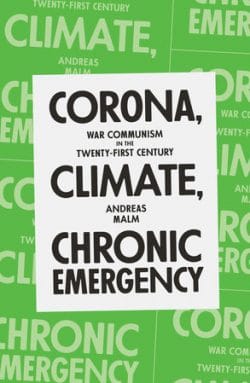
I haven't yet read Andreas Malm's recent and exciting-looking book (Corona, Climate, Chronic Emergency), but I will soon. Meanwhile, here are my thoughts on an interview he gave for Jacobin earlier this summer. He presents a great diagnosis of the COVID-19 crisis so far, and I agree with much in it – for instance when he points out that social democracy has no concept of catastrophe. But ecological war-communism? My take is that, yes, a massive state intervention to stave off climate catastrophe is needed, but it is just as unrealistic to expect it to succeed as it is to put hope in market mechanisms. Why? Because such intervention goes against the interests of the elites that run not only the economy but also the state. We are therefore more likely to end up in post-apocalyptic breakdown rather than in a state-led rescue of the climate. That doesn’t mean that we should abandon the idea of revolution. The struggle for a socialist future must go on even when everything falls apart. Today we might feel that we have a choice between socialism and barbarism, but this choice isn’t made once and for all. Even if we end up in barbarism we mustn’t give up hope in socialism.

I'll add some of my thoughts on the future, pasted from a text I wrote last year. Depending on how responses to the climate crisis unfold, I imagine that three different scenarios are possible when looking at the so-called developed world: 
  1. Transformative response: Politicians and society at large respond in an adequate way, giving us a chance of breaking with the pathway towards catastrophe. This response involves a massive transformation of the economy in order to stop destructive practices and channel investment into alternatives, massive investments into adaptation, and massive transfers of wealth to further socio-eonomic justice and prevent social disruption. The transfers are needed to “democratize survivability” (Clive Hamilton) and uphold at least a semblance of egalitarianism and social solidarity. This scenario implies a revolutionary break with the socio-economic system as it has functioned for centuries. Resistance from elites will be fierce. In addition, mass protests can be expected if the transition is carried out without consideration for the material interests of ordinary people. Unfortunately, this scenario is unlikely in the absence of strong social movements and a unified public opinion committed to ecological concerns and socio-economic justice.
  2. Business-as-usual: this response involves stepped-up efforts to manage climate change but within a framework set by existing institutions and prevailing practices. Drastically raising prices (e.g. of fuel) or imposing other burdens on ordinary people is avoided out of fear of mass protests. Transfers of wealth from elites is also avoided since the elites are too powerful to be challenged. This scenario is highly plausible. However, since it fails to address the causes of the crisis it risks leading over to the third scenario.
  3. Collapse: important social functions break down. This can happen both through direct environmental factors (global temperature change affecting agriculture, water supply, contagion, extreme weather, rising sea levels etc.) and indirectly, through escalating political and social crises (breakdown of global international order, political turmoil, social unrest, rising criminality, civil war, interstate war, increasing poverty and polarization, mass migration). This too will involve radical transformations of the socio-economic order but in a largely uncontrolled and chaotic way. Preparing for this scenario will be difficult, but must include organizing at grassroots level, community-building and local experiments in small-scale “resilient” living. 
The first scenario implies a radical transfer of power to the state. The logic of this scenario points in the direction of what Joel Wainwright & Geoff Mann call the “climate Leviathan” and what Malm calls ecological war-communism. But as should be clear from my notes, I believe the third scenario is more plausible. Nothing can be predicted with certainly, of course, but it would be foolish not to prepare for all scenarios. When I write prepare, I mean both on a personal level - in regard to how to conduct our lives - and politically, in regard to how to wage the struggle for a socialist, non-barbaric future. Here's my suggestion: we should do what we can to pressure the state to follow the first scenario, but let's not despair if we fail - for it is, unfortunately, likely that we will fail. We shouldn't despair, for there's another struggle we should be engaged in at the same time, namely the struggle against the injustices and the suffering that are likely to follow from the third scenario.

         MR Online | A review of Andreas Malm's Corona, Climate, Chronic Emergency: War  Communism in the Twenty-First Century

Addendum (2021-01-06): I've now read the book. It's great - but my assessment above still stands!

Monday, 11 March 2019

Measure, or Hegel’s theory of destruction

There is a justly famous subsection in Hegel’s Logic where he describes “the sudden conversion into a change of quality of a change which was apparently merely quantitative” (p. 335). This subsection, as far as I know, contains the clearest expression in his writings of the famous dialectical leap (or Umschlag) from quantity into quality. Below I'd like to offer a few reflections on the relevance of this idea for some present-day discussions, e.g. climate change and the idea of emergence.

The relevant passages occur in the context of Hegel's discussion of what he calls “measure”. According to Hegel, everything that exists is determined by the magnitudes, or quantities, of the things that constitute it. When a particular magnitude becomes defining for the entity in question, it is called measure. For example: a dwarf that grows above a certain size is no longer a dwarf. A piece of sandy land needs to exceed a certain size before we call it a desert. Hot days need to continue with a certain regularity before we can speak of climate change, and so on. The size or magnitude (a quantity) is thus part of what defines the thing (a quality). As Hegel writes, the specific quantity (or quantum) “is now the determination of the thing, which is destroyed if it is increased or diminished beyond this quantum” (p. 333f). 

According to Hegel, measure is a paradoxical. This is because we usually can’t find anything in the concept of a thing that pinpoints the exact quantitative limit where a qualitative change must occur. This makes us think that we can vary the quantity without affecting the quality. A forest needs to have a certain size in order to be a forest, but it will surely remain a forest even if we cut down one tree. A heap remains a heap even if we remove a grain of sand from it, and a hair pulled from a person’s head doesn’t make the person bald. Yet, obviously, if we keep cutting, removing and pulling we will eventually arrive at a point where the forest and heap will disappear and the person will be bald. What Hegel describes here is the so-called sorites paradox (from the Greek word for heap).    

Hegel concludes that:

... the destruction of anything which has a measure takes place through the alteration of its quantum. On the one hand, this destruction appears as unexpected, in so far as the quantum can be changed without altering the measure and the quality of the thing; but on the other hand, it is made into something quite easy to understand through the idea of gradualness. (p. 334f)

This passage is remarkable for two reasons. The first is the range of Hegel’s claim. He claims that anything can be destroyed through quantitative alterations (this is the only possible interpretation since “everything that exists has a measure”, p. 333). Hegel is clearly aware of the gravity this lends his statement. He goes out of his way to argue that the examples he has given about heaps and baldness “are not a pointless or pedantic joke” (p. 336). Instead, they point to a paradoxical quality that adheres to everything that exists. There’s a brittleness to things which we cannot grasp if we focus only on their quality, on the way we understand them through concepts. The destruction of the State or of great fortunes are two further examples:

Quantum... is the aspect of an existence which leaves it open to unsuspected attack and destruction. It is the cunning of the Notion to seize on this aspect of a reality where its quality does not seem to come into play and such is its cunning that the aggrandizement of a State or of a fortune, etc., which leads finally to disaster for the State or for the owner, even appear at first to be their good fortune. (p.336)


This is a magnificent passage. That it comes like a bolt out of the blue in the midst of Hegel’s long, notoriously abstruse and seemingly apolitical discussions about quantity and quality only makes it more impressive. No wonder his idea of the transformation from quantity to quality later came to inspire hosts of revolutionaries!

Secondly, Hegel points to an interesting curiosity. The destruction is always unexpected, he claims, and this despite the fact that it is quite easy to understand what causes it. Strangely, it’s not because of ignorance that we are surprised by the destruction of a State or a fortune. On the contrary, we are surprised because the concepts we use tell us that small quantitative changes in things won’t affect their quality. We know that removing one grain of sand from a heap won’t make the heap disappear, because that’s part of the concept of a heap. That’s why politicians and capitalists, and others too, are justified in thinking that a little more aggrandizement won’t hurt.

Who can avoid thinking here of global warming? We all know that releasing greenhouse gases into the atmosphere is bound to cause global catastrophe, yet we go on thinking that “a little more won’t hurt”. And we are quite correct in thinking so. Surely, it can’t possibly make any difference to the global climate whether I choose to walk to my job today or to take the car. Similarly, it doesn't make any sense to claim that any particular molecule of CO2 is decisive in causing global warming. It’s precisely because we are so irrefutably correct that we’re in for a surprise when we realize that the catastrophe is here. To put it differently, we can’t stand with a measurement instrument in hand and say: now the catastrophe begins. What happens is rather that, when the dialectical Umschlag finally occurs, we realize that the catastrophe has been going on all the time, and that we were living in its midst even when we still thought that things were fine. The Umschlag brings with it a shift of perspective from which it becomes possible to project the origins of the catastrophic process far back into the distant past. To awaken to the catastrophe of global warming is thus to realize not only that the catastrophe is here, but that it has been unfolding ever since the industrial revolution first brought steam engines into the world. It's not just that quantitative changes give rise to qualitative ones; there is also an opposite process, through which the qualitative shift produces a certain version of the past which tells us which quantitative processes should be deemed relevant and important. That's why the awareness of catastrophe often seems to include the realization that the catastrophe isn’t new. The catastrophe started already when we cut the first tree, removed the first grain of sand, and plucked the first hair.

The economy is perhaps an even better example of how changes both surprise us and don’t surprise us. I’m not thinking here of the constantly recurring speculation bubbles, which certainly surprise us so often that they no longer surprise us, so much as of the ideology of endless exponential growth. Mainstream economics has so far failed to make sense of such growth, which clearly leads to absurd consequences if extrapolated far enough into the future. What seems to be missing in the models used in economic theory is that they fail to acknowledge that their concepts are defined by a “measure” which sets limits to the magnitudes that they can comprehend. If we think that two per cent annual growth every year is good, but that endless exponential growth is an absurdity, then we clearly have a problem in how to relate quantity to quality. To be more precise: our entire economy is built around the sorites paradox.

At this point, I think it’s not far-fetched to link Hegel’s ideas to present-day discussions about emergence. Emergence is what occurs when it is possible to discover a quality in the whole that doesn’t exist in the parts. In many well-known examples used to illustrate emergence in the field of complexity theory, the emergent quality hinges on quantitative change. Crowd behaviour, for instance, arises from a quantitative increase in the number of people. Mobilization processes in social movements, the diffusion and establishment of new technologies, or the way size impacts organizations are other examples. 

Yet when we look closer at the idea of emergence we discover an ambiguity related to how it brings together qualitative and quantitative change. On the one hand, emergence is a causal process, in which a macro-level phenomenon results from complex, interlocking processes originating on the micro-level. On the other hand, emergence is also the result of a conceptual Gestalt shift, or shift in perspective, which in itself says nothing about causality. As an example, we can return to the heap of sand. The heap isn’t “caused” by the grains of sand in any ordinary sense of the word. For instance, there is no temporal sequence such that we first have grains and then a heap. If we dump a load of sand from a bucket, the heap exists from the start. In many discussions about emergence, it seems to me that a clearer distinction between the causal and the conceptual is needed. Exclusively focusing on the causal aspect of emergence easily leads to debates about directions of causality – whether it can only be from micro to macro, or the other way round or between macro-entities as well. While these discussions are important enough, they shouldn’t obscure the fact that causality alone can never explain emergence. Emergence also depends on our ability to capture changes in quality. Without that ability, a dwarf that grows in size would simply be a big dwarf, not something qualitatively different. Nothing would be surprising to such thinking, since nothing qualitatively new would ever happen. On the other hand, exclusively focusing on the conceptual aspect would be equally bad, since it would make us blind to the forces that undermine our concepts, to the way they are “open to unsuspected attack and destruction”, to quote Hegel. Without understanding those forces, we’d deprive ourselves of means for understanding change. All we would have would be one surprising change after the other.

To capture both the causal and the conceptual side, I think it is worthwhile to return to Hegel and to how he describes the transformation of quantity into quality as a process that paradoxically leaves us both surprised and not surprised at the same time. What Hegel seems to be saying is that quantitative processes – that may well involves causal mechanisms, such as the greenhouse effect – compel us to conceptual shifts that allow things to appear in a qualitatively new way. The compulsion here, however, is not of a causal nature in the sense of a law-like regularity or automatic reflection. The compulsion arises as a response to surprise, just as when we suddenly realize that the heap of sand has disappeared. This is significant, because it shows that Hegel is not an idealist in the sense that we can disregard experience. As I’ve argued elsewhere, his idealism consists in his belief in the ability of thought to retrospectively endow experience with meaning by shaping it into a conceptual totality. 

The question with which I would like to end my reflections today is this: doesn’t Hegel’s remarks on the subversive nature of quantitative change also provide an opening for idealist self-criticism? Even if Hegel opens up thought to experience, his understanding remains conceptual and organized around qualitites. But an important lesson from his discussion about measure is that quantitative changes are radically subversive. No matter how correct and justified we are in clinging to the quality of the world as we comprehend it, quantitative changes continually undermine and destabilize it - precisely because they takes place “below the radar” of conceptual thinking.


Reference:

Hegel, G. W. F. (1969) Science of Logic (tr. A. V. Miller), Oxon: Routledge. 


Thursday, 7 March 2019

Climate change is here, and that means new struggles


It’s important to think ahead. For everyone, not just for social scientists. And the future is bleak. Regardless of whether we look at resource depletion or climate change, it’s almost certain that catastrophic disruptions of the way we organize our societies await us. To many people, the catastrophes are already here. I stress that not to induce hopelessness, but to encourage all of us to think about what it means and to discuss it together. Above all, we need to sharpen our eyes to what new conflicts will emerge or become more central in a future of ecological devastation and diminishing material prosperity. To accept the inevitability of catastrophe doesn’t mean passivity at all. It means discovering a host of new struggles.

Clive Hamilton makes two important points in his Requiem for a Species: Why We Resist the Truth about Climate Change (Earthscan, 2010). First, he stresses the need to mourn. Rather than clinging to hopefulness – which he describes as a “means of forestalling the truth” – we should allow ourselves “a phase of desolation... in short, to grieve” (p. 211). But, secondly, he also stresses the need for mass movements in order to resist elites. One of the great dangers of climate change is that it may lead to:
…a retreat to self-preservation in which the ruthless and the wealthy use their power to control dwindling resources and exclude others form sharing in them. It is to prevent this from happening that... I urge the mobilisation of a mass movement to build a countervailing power to the elites and corporations that have captured government. In short, a revived democracy is the only means of fighting the effects of climate change in a humane way. (p. 218)

In short, we must build democracies that “do not abandon the poor and vulnerable to their fate while those who are able to buy their way out of the crisis do so”. The goal must be to “democratize survivability” (p. 223).

So here’s another reason for the importance of “climate justice”. Justice is necessary not just to distribute burdens for mitigation fairly or to compensate for historical emissions. It’s necessary from the point of view of adaptation too, in order to avoid having climate change result in a Hobbesian war. Facing the reality of climate change means facing the threat of a brutal, exterminist future in which ruthless oligarchs protect themselves while large swaths of humanity perish. To prevent that, we need to make efforts already now to reduce social inequality and strengthen the political rights of those whose position in society is weakest. That’s surely a struggle that’s still worth fighting, even if disruptive climate change per se can no longer be averted.

Framing the climate crisis in these terms helps us gain a better view of the stakes of some other recent political debates. The so-called refugee crisis, for example, is clearly linked to climate change in many ways. The way societies in Europe and other parts of Global North reacted to the crisis gave a foretaste of how these societies may react to diminishing material prosperity in the future. With the crisis, we saw a right-wing shift across the political landscape of the Global North, a new love of walls that was not least fuelled by the argument that we can’t afford accepting refugees because of the burden they place on our economies. Isn’t this readiness to sacrifice others with reference to a sacrosanct economy a glimpse of the barbaric future Hamilton warns us about?

We can’t have a society that can only act morally when it’s rich. Such a society would condemn us to hell the moment the economy runs into decline. Unless we find at least relatively decent ways of living together that don’t presuppose economic growth, it’s not just the refugee crisis that we won’t be able to deal with. We won’t be able to deal with the ecological crisis either.

Another issue concerns neoliberalism. Neoliberalism isn’t just about economics. It’s also a political project involving the destruction of rights. Its history since the late 1970s shows how quickly rights and welfare systems can be dismantled when economic elites see their interests threatened. Even as I write, the government of Sweden (where I live) is looking for ways to restrict workers’ right to strike, justifying this with the need to limit disruptions of the economy. It’s easy to imagine a host of other rights being abolished or curtailed as climate change and resource depletion threaten the profitability of the economy – the right to public access to information, the right to free schooling, the freedom of the press, and so on. If Hamilton is right, and I believe he is right, weakening these rights is surely the stupidest and most counterproductive thing we can do. Weakening them means strengthening the very elites that we ought to mobilize against. Accepting the economy as a valid excuse to outlaw strikes or to build walls is to make ourselves hostage to these elites who claim the power to define our economic interests, but whose own interests are in fact opposite to ours.

To summarize this post, I believe that we really need to have a public debate about how to manage processes of material decline, and how that can be done in a way that minimizes suffering. Not just for the sake of refugees, but for the sake of everyone. If the word ecology indicates a focal point for many conflicts today, it’s not only because we must struggle against climate change and resource depletion, but also because of the many new conflicts that are emerging because of ongoing climate change and resource depletion.

I once used the word “post-apocalyptic environmentalism” for environmental activism that takes its departure in catastrophes that are already occurring or that are seen as inevitable. Perhaps the association to post-apocalyptic fiction is not altogether misplaced. Such fiction practically always shows heroes and heroines who continue fighting and struggling, even “after the end”, in the desolate landscapes that remain after the cataclysm. I think it’s possible to find traces of a similar heroism in today’s climate activism – but I’ll write more about that in a later post!

Nausicaa - a post-apocalyptic hero

Tuesday, 13 February 2018

Dark Mountain and hope: some quotes and reflexions

No emotion lends itself so well to paradoxical formulations as hope. Writing this I recall Walter Benjamin's words at the end of his essay on Goethe - “Only for the sake of the hopeless are we given hope”. Yes, this may well be true. There is a logic connecting hope and hopelessness, two emotions that constantly seem to invite each other. Indeed, the very presence of hope testifies to the existence of something bad, something that we want to escape. In that sense, every incidence of hope is cause for pessimism. Perhaps there is no pure hope, no hope without an element of hopelessness? But conversely, isn't it true that one sometimes experiences how giving up hope can be a cure against hopelessness?

When asked by an interviewer if he had hope in view of the ecological disaster, Paul Shepard replied: "Of course I have hope. Why not, it’s cheap and available. It is also the last resort” (quoted in Jensen 2004: 256). A seemingly opposite viewpoint is offered by the Salvage magazine: "Hope is precious; it must be rationed".

The curious thing is that both statements ring true, and that's the paradox.

Here's what Naomi Klein wrote after Trump's election: ”To quote a popular saying on the French left, 'The hour calls for optimism; we’ll save pessimism for better times.' ('L’heure est à l’optimisme, laissons le pessimisme pour des temps meilleurs.')”

I realize of course that hope isn't the same as optimism. Hope is a feeling not wholly under our conscious control, while optimism is a cognitive assessment. Rebecca Solnit puts it well when she writes that both optimism and pessimism are set views of the future and both provide excuses for inactivity. Hope, by contrast, is to see the future as open and thus calling for action (Solnit 2006; also Ehrenreich 2009:3, Weber-Nicholsen 2002:183). Yet despite this difference, the paradoxical quality of hope often seems to reflect on statements about optimism (and pessimism) as well, at least to the extent that such statements are meant to induce a feeling of hope.

I'd like to use these remarks about hope as a way of approaching and making sense of two books I've read recently, Paul Kingsnorth's Confessions of a Recovering Environmentalist and Other Essays (2017) and Walking on Lava: Selected Works for Uncivilised Times (2017), an anthology of texts produced by the Dark Mountain collective (of which Kingsnorth is a co-founder). Dark Mountain is a hugely interesting group of writers, artists and activists who came together in 2009 to put words on the experiences of loss accompanying the decay and collapse of civilization. The fundamental gesture of Dark Mountain consists, I believe, in giving up hope that "the world can be saved". Instead, the group insists that accepting loss and honestly confronting the fact that the catastrophe can no longer be avoided is a liberating act. In a debate with fellow enviornmentalist Wen Stephenson, Kingsnorth expresses it as follows:
This may sound a strange thing to say, but one of the great achievements for me of the Dark Mountain Project has been to give people permission to give up hope. … I don’t think we need hope. I think we need imagination. We need to imagine a future which can’t be planned for and can’t be controlled. I find that people who talk about hope are often really talking about control. They hope desperately that they can keep control of the way things are panning out. … Giving up hope, to me, means giving up the illusion of control and accepting that the future is going to be improvised, messy, difficult. (quoted in Stephenson 2012)

Whereas much environmentalism until now has employed an apocalyptic rhetoric, pointing to the threat of a future, global catastrophe only in order to enable us to avoid it, Dark Mountain instead exemplifies what I've called a new post-apocalyptic form of environmentalism which sees catastrophe as something that's already here: as already having happened, as ongoing or as unvaoidable.

In post-apocalyptic environmentalism we encounter a new paradox. Don't people need hope in order to become activists? It's a well-known saying that people don't join movements because of pessimism. As Klein points out in the quote above, pessimism should probably be "saved for better times" if you want to stop bad things from taking over entirely. In regard to climate activism in particular, researchers have pointed to the centrality of the emotion of hope in mobilizing and sustaining activism (e.g. Ojala 2012). Even if emotions such as fear, anxiety, despair or depression may exist among activists, hope is still indispensible, mediating the other emotions so as to motivate action (Gardner 2017, Kleres & Wettergren 2017). At the climate summit in Paris 2015 (COP21), well-known environmental organizations such as Greenpeace made a point of delivering a bright and hopeful message, praising the deal as an important breakthrough. The aim was to avoid generating feelings of disappointment among activists and in the general public, and thereby maintain trust in the efficacy of activism (see e.g. Thörn et al 2017: 240f).  

To understand post-apocalyptic forms of activism, as in Dark Mountain, we need to drop the premise that all mobilization needs hope in the sense of upbeat, optimistic messages - the "positive thinking" lambasted by Barbara Ehrenreich in her 2009 book Bright-Sided. Dark Mountain is the antithesis of such thinking.

The answer to the riddle is, I believe, that Dark Mountain relies on the paradoxical quality of hope - the fact that giving up hope may be a way to gain hope. Sean Parson (2017) advocates making use of this paradox in activism, citing Adorno as the great theoretician of “revolutionary pessimism” in which politics is generated by “embracing doom”. An even blunter example is Roy Scranton’s Learning to Die in the Anthropocene (2015) which advocates a radical-Buddhist rejection of hope. By realizing that we are “already dead” and that our civilization, including capitalism, are also dead, we can let go of our fear. That is the only way of seeing what possibilities we have to adapt to the new reality. Somewhat similar is the suggestion by Flores & Rousse (2016) to embrace ecological finitude, learning to die as a species, while at the same time finding space for “fulgor” – the faint glimmer or glow of a dawning reconfiguration – and radical hope as a commitment to possibility. Here again we see how important it is not to confuse hope with optimism. In all these writers and thinkers, hope co-exists with a lack of optimism, and perhaps it even arises because of this lack. Like Kingsnorth, they also all emphasize the need for imagination - for new ideas and new stories - and that giving up hope may be the key to freeing up this imagination.

The best theoretician of this kind of paradoxical mechanism is perhaps the philosopher Jean-Pierre Dupuy, who has put forward the idea of “enlightened doom-saying” and post-apocalyptic retroactivity as a way of handling climate change and other environmental threats (Dupuy 2007/2008; 2013: 27f, 46f). The problem, he states, is that the world is headed for doom, but people don’t prevent it since the future is not conceived as real. It appears unreal precisely because we believe in our free will, in our capacity to "act otherwise" which makes it impossible for us to believe that the worst will occur. Only retrospectively will it appear possible. The catastrophe “possiblizes itself” – and that is our problem, because to prevent it one needs to believe in it before it occurs. What is the solution? To project oneself into the future and look back at our present from there. One must allow “the mind to project itself into the aftermath of the catatstrophe, and treat the event in the future perfect tense” (Dupuy 2013: 204).

This strategy is described very well by Zizek in In Defense of Lost Causes. There he points to the notorious “pessimism” of Adorno and Horkheimer as an example of this paradoxical strategy: “While traditional Marxism enjoined us to engage and act in order to bring about the necessity (of communism), Adorno and Horkheimer projected themselves into the final catastrophic outcome perceived as fixed (the advent of the 'administered society' of total manipulation and the end of subjectivity) in order to stimulate us to act against this outcome in our present” (Zizek 2008: 460). Here the very rejection of ostensible “hope” becomes the precondition for hope. Only by renouncing the seemingly hopeful prognosis that the catastrophe can be averted can we free ourselves from paralysis and act.

Here it's possible to object that Dupuy isn't really accepting loss. Isn’t he still hoping to avert or at least postpone the future catastrophe by using retroactivity as an intellectual ruse? What he calls enlightened doom-saying at first sight does not appear to be based on a genuine post-apocalyptic acceptance of catastrophe; instead it is supposed to spur us to undo the catastrophe that fate has ordained for us: “to believe in fate is to prevent it from happening” (Dupuy 2013: 32). This may seem like a form of rationalism, a mere strategy for averting the worst, which is still tied to the linear perspective on time which Dupuy claims to be criticizing. But to understand Dupuy's strategy as a rationalism is to do it a disservice. It appears to me that the strategy becomes genuinely persuasive only when seen as practiced by subjects groping their way towards recovery from a traumatized or melancholic state. Rather than as a calculated trick implemented by a wholly self-controlled subject, I prefer to see it as a strategy that doesn’t have to be wholly conscious. This is why his idea is relevant in the context of Dark Mountain’s literary production where a strategy similar to Dupuy's post-apocalyptic retroactivity appears to be involved, albeit in a form that is perhaps unconscious or only half-conscious.

Dupuy himself seems to admit that full consciousness of the strategy is not required when he writes that the post-apocalyptic future should be believed in as a “fate” that is somehow similar to the way we believe in the world we encounter in literature: “We must… believe in fate exactly as one believes in a work of fiction” (ibid. 193). This stance is seemingly rational but also a way of working-through and liberating the mind in a way that could be described as only half-conscious or even dreamlike.

Michael Ortiz Hill provides an illustration of what this form of belief might mean in his discussion of apocalyptic dreams. To begin with, it is crucial not to confuse the literal and the psychic apocalypse. “In the psyche… images often have different implications than in our waking life, and the apocalyptic initiation may well require destruction” (Hill 1994: 53). Entering the “apocalypse of the psyche” may be a way of avoiding “enacting apocalypse in the world” literally. What is suggested here is that the confrontation with apocalyptic destruction in dreams can function as a catharsis, freeing us to act with greater sensibility and freedom in our waking lives. I would like to suggest that this form of confrontation is aimed at in the literary production of Dark Mountain as well as in Dupuy's “enlightened doom-saying”. Rather than a purely rational operation, this doom-saying can be enacted in dreams and played out in the unconscious as well as in literary production. The point is to psychically visit the apocalypse to free ourselves from the fixations that, in our ordinary lives, prevent us from taking action against the catastrophic course of events that unfold around us in reality. There is thus a therapeutic function to anticipating loss – to liberate the mind, and find something positive in the loss, and thus, perhaps, regain the ability to avert the worst.

It's time to wind down, but before finishing I'd like to offer a final quote. Here's Max Brod recallling a conversation with Kafka (quoted by Benjamin).
‘I remember,’ Brod writes, ‘ a conversation with Kafka which began with present-day Europe and the decline of the human race. “We are nihilistic thoughts, suicidal thoughts that come into God’s head,” Kafka said. This reminded me at first of the Gnostic view of life: God as the evil demiurge, the world as his Fall. “Oh no,” said Kafka, “our world is only a bad mood of God, a bad day of his.” “Then there is hope outside this manifestation of the world that we know.” He smiled. “Oh, plenty of hope, an infinite amount of hope – but not for us.”
Infinite hope indeed, but this invocation of hope only serves to strengthen the impression of infinite hopelessness. And isn't that the perfect way to end this essay?


References:

Dark Mountain (2017) Walking on Lava: Selected Works for Uncivilised Times, ed. by Charlotte Du Cann & Dougald Hine & Nick Hunt & Paul Kingsnorth, White River Junction: Chelsea Green Publishing.

Dupuy, Jean-Pierre (2007/2008) “Rational Choice before the Apocalypse”, Anthropoetics - The Journal of Generative Anthropology 13(3) (Fall / Winter); http://www.anthropoetics.ucla.edu/ap1303/1303dupuy.htm (accessed 2016-02-03)

Dupuy, Jean-Pierre (2013) The Mark of the Sacred, Stanford: Stanford University Press.

Ehrenreich, Barbara (2009) Bright-Sided: How Positive Thinking is Undermining America, New York: Metropolitan Books.

Flores, Fernando & Rousse, B. Scot (2016) “Ecological Finitude as Ontological Finitude: Radical Hope in the Anthropocene”, Telos (177): 127–143.

Gardner, Claire (2017) “Oscillating Futures: Visions of Apocalypse Amongst Climate Activists”, interview by Odette Shenfield, Demos, June 2; http://www.demosproject.net/oscillating-futures-visions-of-apocalypse-amongst-350-org-climate-activists/ (accessed 2017-10-25).

Hill, Michael Ortiz (1994) Dreaming the End of the World, Dallas: Spring Publications.

Jensen, Derrick (2004) “Paul Shepard”, pp. 248-259, in Listening to the Land: Conversations about Nature, Culture, and Eros, White River Junction: Chelsea Green.

Kingsnorth, Paul (2017) Confessions of a Recovering Environmentalist and Other Essays, London: Faber & Faber.

Kleres, Jochen& Åsa Wettergren (2017) “Fear, hope, anger, and guilt in climate activism”, Social Movement Studies 16(5): 507-519

Ojala, Maria (2012) “Hope and climate change: the importance of hope for environmental engagement among young people”, Environmental Education Research 18(5): 625-642.

Parson, Sean (2017) “Cthulhuscene: Ecological Catastrophe, Cosmic Horror, and the Politics of Doom”, Reading Super Heroes Politically (blog), February 24; https://readingsuperheroespolitically.wordpress.com/2017/02/24/cthulhuscene-ecological-catastrophe-cosmic-horror-and-the-politics-of-doom/ (accessed 2017-11-25).

Scranton, Roy (2015) Learning to Die in the Anthropocene: Reflections on the End of a Civilization, San Francisco: City Lights Books.

Solnit, Rebecca (2006) Hope in the Dark, New York: Nation Books.

Stephenson, Wen (2012) “‘I withdraw’: A talk with climate defeatist Paul Kingsnorth”, The Grist, April 11; http://grist.org/climate-energy/i-withdraw-a-talk-with-climate-defeatist-paul-kingsnorth/ (accessed 2018-01-09).

Thörn, Håkan & Cassegård, Carl & Linda Soneryd & Åsa Wettergren (2017) “Hegemony and Environmentalist Strategy: Global Govenance, Movement Mobilization and Climate Justice”, pp 219-244, in Håkan Thörn & Carl Cassegård & Linda Soneryd & Åsa Wettergren (eds.) Climate Action in a Globalizing World: Comparative Perspectives on Environmental Movements in the Global North, New York: Routledge.

Weber Nicholsen, Shierry (2002) The Love of Nature and the End of the World: the Unspoken Dimension of Environmental Concern, Cambridge: MIT Press.

Zizek, Slavoj (2008) In Defense of Lost Causes, London: Verso.


Tuesday, 30 January 2018

Salvage as utopia, or: why are anti-capitalist utopias so... capitalist?

One perhaps unfortunate side-effect of the focus on the super-rich, or "1%", in so much anti-capitalist criticism in recent years is that it conveniently forgets the capitalism pervading the rest of society. This forgetting is understandable, of course, considering the mindboggling levels of income, wealth and power concentrated in the hands of a tiny elite today. The gap between the super-rich and the mass of small-scale producers, traders and entrepreneurs has taken on the semblance of a class division. Where do the profits end up? It's certainly only a trickle that ends up with small shop-owners or family-run businesses, not to speak of e-waste scavengers, private taxi drivers or freelancers. Indeed, the very idea of a class divide between "capital" and "labour" begins to lose meaning when much of what was once counted as labour is redefined as hired or subcontracted services provided by private enterprises consisting of one or just a few people. Regardless of the fact that the latter are capitalists on paper, big capital is capable of skimming surplus value off their work just as comfortably as from wage labour. Just as the reality of exploitation is hidden by the employment contract in the case of wage labour, so it can be hidden when it takes place among capitalists by a contract between seemingly equal business partners.

What I'd like to do here is to analyse what the perception of a class divide within the capitalist class does to the utopian imagination. It's no news that the utopian imagination today hardly seems capable any longer of mobilizing any radically non-capitalist, or communist, visions. In literature as well as scholarly accounts, there's instead a tendency to relish in rose-coloured visions of a thriving, buzzling market economy in which commodities mostly derive from salvage or simple do-it-yourself production. These writings, although suffused by abhorrence for the excesses symbolized by the parasitical "1%", idealize a particular kind of capitalism, a capitalism with a "human face", so to speak, from which the excesses have been purged. It's not my intention to reject visions of this kind, but I would like to point out that they're ambiguous in a very interesting way. They have a utopian lustre, as if salvage and small-scale production per se signified a post-capitalist economy, but they are also, strikingly, portrayed as part and parcel of a rather rapacious, brutal and Hobbesian form of capitalism. Visions of this kind thus present a riddle. What exactly is the utopian content of these visions? Why are we attracted to them? Are they just a trap to make us affirm capitalism even as we criticize it?

Let me turn to China Miéville's 2012 novel Railsea (written in a genre which the author himself calls "salvagepunk") to illustrate this ambiguity. The world of the novel is post-apocalyptic, but still recognizably capitalist. Humankind subsists largely on salvage, using trains to "sail" a flat, poisoned earth covered with a carpet of railways known as the "railsea" - the remains of an old, forgotten civilization whose technological achievements are far beyond the grasp of the surviving remnants of humanity. The first thing to note is that the depiction of this future world is not particularly bleak. In large parts, it's an adventurous and carnivalesque world. The gaze it turns on salvage is filled with fascination and fondness. Take for instance the following description of Streggeye, a lively "port" town where Sham - the book's protagonist - admiringly watches the salvage trains come in.
They were like no other rolling stock on the railsea. Patchwork vehicles. Powerful engines, wicked shunters at the front, train sides riveted with cladding, bristling with the peculiar tools of the salvor’s trade. Drills, hooks, cranes, sensors of various unorthodox kinds, to find & sort through the millennia of discarded rubbish that littered the railsea. Bits of salvage used & incorporated. On the topside decks salvors themselves in their distinctive clothes, tool-belts &bandoliers & stained leather chaps, snips of treated cloths & plastic feathers & showy bits & pieces pulled from the earth & miraculously unruined. Helmets of various complicated designs.
    First the city authorities would come aboard & bargain for what salvage they wanted. Then high-rolling clients, the Streggeye rich. & finally, if the salvor crews were feeling generous & had a few days, they would run a market.
    Their antique & reclaimed wares were set on stalls on the dockside, according to various taxonomies. Pitted & oxidized mechanisms from the Heavy Metal Age; shards from the Plastozoic; printouts on thin rubber & ancient ordinator screens from the Computational Era: all choice arche-salvage, from astoundingly long ago. & the less interesting stuff, too, that discarded or lost anything from a few hundred years ago to yesterday (Miéville 2013: 97f)
There's something here that reminds me of preindustrial European capitalism. The involvement in salvage activities of city authorities (and, as we learn later in the book, privateers and navy "war-trains") suggests a collusion between political power and capital that a variety of writers from Braudel and Wallerstein to Kocka have argued is typical of the capitalist world-system. The world of the railsea is thus hardly post-capitalist. And indeed, why should it be? As Evan Calder Williams points out, salvage is firmly enmeshed within the circulation of capital:
By now, the meaning of salvage has stabilized to the point where it can be paraphrased: the discovery of hidden value or use in what appears beyond repair or sale – or, at the least, a wager that the already ruined might still have some element worth saving, provided one knows where and how to look. In this form, it designates a fundamental mechanism within the circulation of capital. It is a relentless search for every last scrap of value. (Williams 2015: 845)
As a "search for every last scrap of value", salvage might not seem a likely abode of utopian possibilities. Yet distinct glimpses of such possibilities are offered in the book. We see this in a key scene when Sham arrives at the house of the siblings Caldera and Dero and asks to join them as salvors. It must be exciting, he says, to uncover the past. But Caldera admonishes him: "you don’t uncover the past if you’re a salvor: you pick up rubbish. The last thing I think you should think about’s the past. That’s what they do wrong here" (ibid. 145). Let me quote Zak Bronson, who nicely summarizes the utopian significance of this scene:
Caldera’s knowledge about the railsea suggests that she has abandoned any desire to uncover objects’ original use; instead she creatively repurposes it for its contemporary possibilities. This is something that Sham notices when he arrives at Caldera’s home, which serves also as a scrapyard for rusted-out, discarded metal. He marvels at her salvaged waste, including a stack of washing machines that arc over the entrance to their property. Sham wonders, “Why would you use arche-salvage for something it clearly wasn’t for? When there were much bloody easier things to build an arch out of?” (156). Caldera’s transformed arch signifies the utopian possibilities of salvagepunk: it turns objects upside down. In the post-apocalyptic world, their value is no longer based on the process of exchange, but on their social function within the new landscape. (Bronson 2014: 94)
I readily agree with Bronson that Caldera's salvage activities - and not least the arch - are the locus of Railsea's utopia. But isn't it significant that these utopian possibilities are not portrayed as in any sense negating the salvage-based capitalism of the railsea world? Just like the washing machines making up Caldera's arch, the salvaged junk brought in by the salvage trains in Streggeye will also be repurposed, disconnected from any past, original use. In regard to what, then, does Caldera's version of breaking with the past represent a utopian possibility? If it consists in creatively repurposing junk for present purposes, then we need to figure out what this "past" is in order to know exactly what the arc is supposed to be a counter-image to.

The answer to this (perhaps not so difficult) riddle comes near the novel's end. Sham and his comrades make their way to the edge of the railsea and, against all odds, manage to find a way out of it. As the first people in millennia, they cross an ancient bridge stretching over an almost endless chasm and arrive at what appears to be a ghost town. There feral figures appear, headed by a sinister tall man.
    What were they, these dwellers beyond the world? Rag-clad, hulking & shaggy, creeping, sniffing, they loped out of the dust that announced them. Ten, twelve, fifteen figures. Big women & men, all muscle & sinew, baring their teeth, coming on two limbs & four, apelike, wolflike, fatly feline. Staring as they came.
    «We have to go,» Dero said, but they could not get past. The newcomers had reached the base of the jetty. & there they stopped. Their dark clothes were so shredded they looked like feathers. They licked their lips; they stared a long time. ... Something was approaching from the ruins. Seven feet tall, sloped, immense. An ancient, powerful man, of great girth. He wore a repatched dark coat, a tall black hat....
    What looked like a degenerate avatar of the god stepped slowly past his fellows, towards Sham & the others. The jetty shook with his great steps. He licked his face in delight.
Amazingly, it turns out that the man, known as the "Controller", represents the ancient corporation responsible for constructing the railsea. The railsea was in fact once a real ocean that was drained by the corporation to increase marketable real estate. Believing that Sham and his comrades have come to settle their debts at last, the Controller triumphantly presents them with a bill.
Caldera stared at the paper. «This is … more money than there’s ever been in history,» she whispered. «It’s gibberish.» ...
    Abruptly, Sham hated them. He didn’t care that they were lost, too, in thrall to a remorseless drive, the hunger of a company presiding over ruin. That refused to allow the fall & rise of civilisations, the visitations & transformations & leave-takings & rubbish-pickings of aliens, the fall of waters, the poisonings of skies & the mutation of the things in the earth, because of the very actions for which they charged, to intrude on their patient accounting. Endlessly extending terms to a humanity unaware they were in debt, that they had for millennia been buying travel-passes on the never-never. All in the hopes that at the end of time, economies would be back in place to pay.
    «Ghost money in Heaven,» Sham said. «Not ’cause it died — ghosts because it weren’t born yet.» He stared the big man in the face. «We,» he said, «owe you nothing.»
    The controller stared at him. His look of hungry expectation slowly changed. To one of uncertainty. Then slowly to one of misery. & abruptly to one of rage.
    He roared. All the Heaven-dwellers roared. They lurched forward. The jetty rocked as they came. (Miéville 2013: 360-363)
So here, in the person of the Controller, Shame and his comrades finally confront the beast, the last and pitiably remnant of today's global finance capitalism. Written as it was in 2012, it's safe to assume that readers wouldn't have had any difficulties in recognizing in the Controller's snickering face the masters of the debt economy that just a few years earlier had wreaked havoc with global finance, plunging whole populations into debt servitude, and yet, despite the enormity of their fiasco, managed to live on basically unscathed by the crisis. In the ensuing fight on the jetty, Sham manages to push the Controller into the sea and that's the end of capitalism - not with a bang but with a whimper.

Now the picture seems clear. Caldera's liberating ability to start anew is the necessary antithesis to this ridiculous zombie-like capitalism, which refuses to let go of the past and over millennia keeps track of accumulated debts that have become irrelevant to the living. Bronson (2014) is clearly right when he points out that Miéville’s novel "taps into the utopian possibilities of repurposing and recreating the world anew out of the wreckage that remains”.

Yet, the simple opposition between the utopian possibilities of Caldera-style salvage/repurposing and the absurd persistence of Controller-style zombie capitalism is complicated and to some extent undermined by the existence of the far less moribund economy of the railsea, which, as we have seen, is also very capitalist. The facile end of the Controller seems to suggest that finance capitalism is nothing but a parasitical remnant that can easily be removed without any damage to the real, functioning economy. This real economy has, after all, grown up and prospered in blissful ignorance of the Controller and his monstrous corporation for ages. And now it is ready to cast off the shell of the old (the "iron cage", to paraphrase Max Weber, has thus reverted into the "light cloak" it was meant to be). The only problem is that Controller-style capitalism is killed off only to make way for another kind of capitalism, namely the salvage-centred railsea economy. How radically new are the utopian possibilities of salvage if salvage is part and parcel of the latter economy?

This, I believe, is how far Miéville's novel takes us. No doubt it would be possible to continue exploring the ambiguities of salvage by looking closer at other examples. Why not discuss Williams' explorations of salvagepunk in Combined and Uneven Apocalypse, Anna Tsing's ruminations on salvage in The Mushroom at the End of the World, or perhaps Steven Jackson's discussions of "repair"? Wouldn't it have been helpful also to consult Marxist discussions of how capitalism relies on resources not generated by wage-labour (such as Jason Moore's Capitalism in the Web of Life)? True, true - but discussing these works will have to wait until some other day.

Before I end, I'd like to propose three theses, which I hope will go some way towards clarifying the ambiguity of salvage.

Firstly, although salvage is today a moment in the circulation of capital, it is also grounded in the need of human beings for survival and subsistence. Through its orientation to use value, salvage may offer glimpses in to a possible post-capitalist life. In that sense, it contains the seed of negating, not just the "1%", but also the railsea economy. The fascination with salvage that is evident in post-apocalyptic fiction stems, I suggest, from this seed.

Secondly, a capitalism relying to a large extent on salvage is different from one based on industrial production. This in turn means that anti-capitalist struggles will also look different. Nicholas Beuret and Gareth Brown (2015) have argued that instead of the wage-labourer, the survivor takes central place as the subject of politics in such struggles. Instead of furthering historical progress and economic development, the survivor "dwells within a collapsing world". At the same time, differences between salvage and labour shouldn't be exaggerated. Labour, as Marx reminds us, is what people do when they're deprived of other means of subsistence. In labour we thus see the same ambiguity as in salvage. A person who is forced to work for a wage - a proletarian - is oriented to subsistence and hence to use values, yet works in a system where what counts is exchange value. Like the worker, the salvor takes part in the movement of capital yet retains an orientation to use value from the point of view of which the logic of capital will appear alien. Depite the fact that the salvor is sometimes formally a capitalist or at least not a member of the class of wage-labourers, it is thus possible to see salvage as a site of potential resistance to the logic of capital - and in this sense there is also a potential continuity between struggles waged in the name of labour and salvage.

Finally, whatever utopian possibilities may grow from salvage are only present as a seed. As long as they remain unrealized, salvage per se is perfectly compatible with capitalism of any type. Moishe Postone once criticized a common mistake made by what he called "traditional Marxists", namely that they treated labour as a transhistorical category, extrapolating it into the future post-capitalist society. Against them, he argued that the point of overthrowing capitalism wasn't the liberation of labour, but the liberation from labour, since the category of labour only had meaning within the relations established by capitalism. In similar fashion, we shouldn't idealize salvage, treating it as a transhistorical category that can unproblematically be extrapolated into the future. Salvage as it exists today is no less enmeshed in capitalism than labour, and shouldn't be transposed into the future as a blueprint for a post-capitalist society. But that doesn't mean that it is mere ideology. Utopias, as Miéville (2015) points out in another text, are not meant to be blueprints but dreams that shock us into action by liberating our imagination.


References

Beuret, Nicholas & Gareth Brown (2015) “Dancing on the Grave: Salvage, The Walking Dead, and the End of Days”, Salvage, 19th of October; http://salvage.zone/in-print/dancing-on-the-grave-salvage-the-walking-dead-and-the-end-of-days/ (accessed 2017-10-23)

Bronson, Zak (2014) “Reproduce, Reuse, Recycle: the End of the Future, Salvage, and China Miéville’s Railsea”, Researchgate, January 2014; https://www.researchgate.net/publication/317175893 (accessed 2017/12/08).

Miéville, China (2013) Railsea, Pan.

Miéville, China (2015) “The Limits of Utopia”, Salvage Vol. 1, 1st of August; http://salvage.zone/in-print/the-limits-of-utopia/ (accessed 2017-10-23).

Williams, Evan Calder (2015) “Salvage”, Journal of American Studies 49(4): 845-859.


Friday, 23 September 2016

Alex Loftus and urban environmentalism

Last week, I finished an interesting book - Alex Loftus' Everyday Environmentalism: Creating an Urban Political Ecology (2012). This is a theoretical book, but Loftus writes like a young activist, desperately hungry for a new and better world. Theoretically, he conjoins the urban political ecology-approach (represented by e.g. Erik Swyngedouw, Maria Kaika and Nikoas Heynen) with the “production of nature”-approach associated with Neil Smith.

Part of what makes this book interesting is that it exemplifies how Smith’s perspective can be developed from being primarily an academic tool into a stance in which theory joins hands with activism. This is quite significant, considering that Foster (2016) has criticized the "production of nature"-approach for its insensitivity to environmental problems. The result of Loftus' intervention is a kind of environmentalist Marxism that is quite distinct, both from today's Eco-Marxism and from older variants of Marxist thinking on nature derived from the Frankfurt School.

But what kind of environmentalism is this? 

Firstly, it is an urban environmentalism. It’s in everyday life as experienced in the urban environment that he finds his foothold – through “reveling in the dirt and grime, the anomie and the creativity: of city life” (Loftus 2012: xiv). As he also puts it: "Within the noise and the dirt, the fumes and the concrete, of the contemporary city, I argue that there are conditions of possibility of sensing this alternative world" (ibid. x).

Secondly, the urban environment is seen as assemblages of social and natural relationships. This means that he rejects the “dualism” between society and nature that is a trait of much environmental thought. Referring approvingly to actor-network theory (ANT), he writes that  “the world is made up of both things and relationships that simply cannot be separated into two boxes labeled ‘nature’ and ‘society’” (ibid. 2).

Thirdly, he rejects the apocalypticism that has long characterized environmentalism (in this, he follows Smith and Swyngedouw, and comes close to what I have described as post-apocalyptic environmentalism). He rejects apocalypticism not because threats to nature aren't real, but because such accounts are disempowering. They feed a sense of powerlessness and “put global futures outside the control of everyday citizens”, and thereby “depoliticise” environmental issues (ibid. xvif).

In all these three respects Loftus comes pretty close to the environmental justice movement (which he he's inspired by; ibid. x) or to what Joan Martinez-Alier (2003) refers to as the "environmentalism of the poor". Characteristic of this form of activism is that it is concerned with livelihood and social justice, rather than with preserving wilderness or "green" government. His inspiration from "justice"-movements is also seen in his choice of struggles around water distribution in Amaoti in Durban as one of his main main examples to visualize and underpin his arguments.

So let's turn to theory. Loftus is inspired by Marx's early writings. Much of the book is taken up with discussions of Lukács, Gramsci and Lefebvre. Along the way we also find briefer discussions of Smith, Eco-Marxism and actor-network theory. I'll briefly go though how he relates to these different theories. Doing so will give us a feel for how he works out and develops a theoretical position of his own.

His point of departure is Neil Smith’s claim in Uneven Development that capitalism produces nature. Loftus fundamentally agrees with this. Yet Smith is also criticized. Firstly, he is said to neglect the importance of the sensuous and embodied ways in which nature is performed. Secondly, he appears to give little sway to nonhuman agency (ibid. xxii, 13f, 27). Despite this criticism, Loftus claims that Smith’s approach shouldn’t be rejected. Instead its dialectical foundations should be deepened (ibid. 16). These remarks indicate the theoretical directions in which Loftus will set out searching for supplement and correct these weaknesses in Smith: we will thus need more on dialectics, the sensuous, and non-human agency.

The main discussion of dialectics comes in his chapter on Lukács. Lukács is appreciated above all for providing a theory of situated practice. Although his idea of the proletariat's unique ability to grasp history in a dialectical way may appear quaint today, it anticipates contemporary standpoint theory. The problem with Lukács lies in his concept of nature. Lukács rejected Engels's attempt to extend the dialectical method to nature. This is problematical since Lukács himself advocates dialectics as the only way to grasp "totality" and break the hold of reificatory bourgeois science. It also seems to go against the grain of his statement (in History and Class Consciousness) that nature is a social category. Despite the fact that Lukács ends up in a self-contradictory position, interpreters like Andrew Feenberg and Martin Jay defend his rejection of Engels as a sound move. Feenberg, for instance, argues that nature, unlike human praxis, constitutes a realm that can be adequately grasped through the "reificatory" methods of natural science (see e.g. Feenberg 1999, 2014). Matters are somewhat thrown into confusion by the fact that Lukács modified his position on nature in later writings (such as his long unpublished defense of History and Class Consciousness and his 1967 preface to a new edition of History and Class Consciousness). Nevertheless, it appears that Lukács could never bring himself to fully extend a dialectical method to the study of nature. Loftus thinks that this is “devastating to his overall argument” (ibid. 64). To fully separate dialectics from nature would “deliver a fatal blow to our efforts to appropriate Lukács for a non-dualistic approach to metropolitan nature” (ibid. 63). The reason? Such a separation fails to confront the reality of "socio-natures" (ibid. 73). However, Loftus argues that Lukács’s difficulties can be overcome by a greater emphasis on how nature is produced through human as well as nonhuman activity (ibid. 66).

Turning to the importance of the sensuous and the everyday, the central theoretician is Lefebvre. However, Lefebvre's own writings on nature are disappointing. He viewed nature as a passive victim of an encroaching society, and he was thus never able to see nature "as an ally". His stance was predicated on a dualism between society and nature that ignored the myriad mixings between the two (ibid. 8, 110). Smith’s signal move, which sets him off from Lefebvre, is precisely to recognize the interpenetration of nature and society, pointing out how capitalism constantly produces nature (ibid. 110ff). Lefebvre's strength, by contrast, lies in his focus on affective and mental conceptions that are missing in Smith, and in his recognition of artistic creation of human praxis. Loftus thus argues that such creative practices can be seen as a model of the sensuous processes through which the production of nature could be carried out (ibid. 113f, 38).

Non-human agency then? Although the direct inspiration seems to be urban political ecology, it is clear that the main, indirect source of this idea is Latour and ANT. The influence manifests itself in Loftus' terminology of "assemblages" and his critique of dualism. Curiously, in certain formulations he comes close to merging dialectics and ANT: Marx, he writes, helps us understand nature in non-dualistic terms, as a dialectical unity in which labour mediates a process in which human and nonhuman are inseparable, or in Latour’s terms form social-natures (ibid. 7). Reading sentences of this kind, it is easy to nod assent to Foster's lumping together of ANT and “the production of nature” (Foster 2016, Foster & Clark 2016). In fairness, however, it should be pointed out that Loftus is careful to stress that the unity of the socio-natural assemblage is dialectical, a relation which he argues that ANT fails to capture. Loftus also concurs with Kirsch and Mitchell in their criticism of ANT: its obvious that nonhuman agency exists but the task is to explain this and thereby to help people regain power over things that have taken on a life of their own (ibid. 73). As Kirsch and Mitchell writes:
But if we are truly to avoid becoming mere "dead theories and dead practices" ourselves, then it remains important that we insistently raise the question that ANT wants so much to forestall: why are "things as such" produced in the ways that they are—and to whose potential benefit? How, to turn Gramsci’s point around, can people struggle to take control of those non-human actors, those things as such, and shape them so that the "nature of things" is really on their side?” (Kirsch & Mitchell 2004: 702)
Ultimately, then, ANT is rejected as insatisfactory since it lacks the emancipatory drive and the rooting in everyday life that Loftus finds in Marxist thinkers.

In this way, Loftus balances his theoretical inspirations against each other, hoping that they will mutually make up for their respective deficiences.

At least as significant as what inspires Loftus is perhaps what doesn't. One might ask how he relates to two other important currents in Marxism that have been as influential as the "production of nature"-approach in theorizing the relation between capitalism and nature: the Frankfurt School and Eco-Marxism. I won't dwell long on the Frankfurt School here. Suffice it to say that Loftus isn't really appreciative of it. He castigated it for its dualism and its incapacitating lament about the "domination of nature". I believe he is unfair in this criticism, and in the future I will try to discuss more at length how a Frankfurt School approach to nature can be made fruitful today (some preliminary reflections can be found here and here).
 
How about the Eco-Marxists then? Clearly there is friction in relation to them. He explicitly criticizes “dualist” perspectives that posit nature “as a force inflicting revenge on the arrogance of human society” (ibid. xvi). Despite Foster’s own rejection of dualism, such an idea of nature as a victim of capitalism that may well some day exact revenge on humanity is surely implicit in Foster's idea of the metabolic rift. Not surprisingly, Loftus criticizes the idea of the rift for its ”vague and atavistic” implications: does Foster really want to return to a society in which the night soil of city-dwellers is used as fertilizer (ibid. 31)? He also criticizes Foster’s “somewhat overstretched claim that Marx was somehow a proto-environmentalist” (ibid. 13). Another difference between Loftus and the Eco-Marxists is Loftus’ stress on sensuousness and artistic practice as a model for the production of nature. Loftus therefore announces that he will “move in somewhat different directions” compared to Eco-Marxists like Foster and Burkett (ibid. 25).
I am less convinced of the centrality of ecological crisis to Marx’s overall understanding of the contradictions of capitalist societies. Nor am I convinced of the overall importance of the theory of ‘metabolic rift’ to a radical politics of contemporary urban environments. Foster’s rediscovery of the roots to Marx’s materialism [in Epicurus] leads to a neglect of key critiques of mechanistic materialism in the writings of Lukács and Gramsci. Even more curious, Foster then condemns these authors as ‘idealist’ and lacking the coevolutionary perspective necessary for a progressive ecological politics. These criticisms are unfounded. (ibid. 25f)
This isn't the place to delve further into this criticism. Let me just state that I agree with the part of it that deals with Foster's "idealist"-accusations (but this again is something I hope to return to it in a future blog post).

Clearly, Loftus finds much less of value in Eco-Marxism than in Lukács, Lefebvre, Gramsci, Smith or Latour. The fact that a theoretical conflict line today seems to run between Eco-Marxism and the "production of nature"-approach is evident also in Foster's harsh and scathing criticism of the latter in recent articles (Foster 2016, Foster & Clark 2016). In these, Foster assimilates the "production of nature"-approach to ANT and refers to both as "monistic" theories. Foster also stresses the superiority of Eco-Marxism as a tool for diagnosing to the damage capitalism causes to nature. By contrast, theoreticians in the enemy camp, like Smith, are insinuated to lack an environmentalist sensitivity or even - like Latour - to have capitulated wholesale to capitalism.

Foster may be right in his criticism of Latour. Whether he is right to condemn the "production of nature"-approach as a whole is more dubious. Having read Loftus, I have a pretty good hunch how he would reply to such criticism. To begin with, he would insist that his approach is as dialectical and as criticial of capitalism as Foster's. In addition, it would be easy for him to demonstrate that his own approach has at least as much affinity to environmental activism as Eco-Marxism. It's quite striking, however, that the kinds of environmentalism to which Loftus and Foster orient themselves are quite different. Foster's Eco-Marxism may be well suited to an environmentalism concerned primarily about damage done to nature. Loftus' position, by contrast, is geared to the environmental justice movement or the "environmentalism of the poor".

Dwelling on the debate between Eco-Marxists and the "production of nature"-approach may seem like a barren exercise. As a reader, one might wonder how meaningful it is to spend attention on these debates, in which theoreticians compete about being the best dialectician while hurling labels like “dualism” and “monism” as abusive invectives at their opponents. However, while reading Loftus, I had the refreshing feeling that theoretical trench warfare was not a prime concern for him. He seemed concerned above all to understand and at least theoretically do justice to the protesting women in Amaoti. In this book he gropes his way forward - picking up one insight from Smith, then another from Lukács, and so on - towards a position more adequate to such protesting women's experience and the alternative world taking shape in their struggles. I wouldn't say that he has solved all theoretical problems. But the road he indicates - seeing humans as part of nature but at the same time viewing this unity as a dialectical one, and basing all of this on everyday experience - deserves to be explored. It may be a way forward, past the trenches, or at least one way forward among others.


Socio-nature?

References

Feenberg, Andrew (1999) “A Fresh Look at Lukács: on Steven Vogel's Against Nature”, Rethinking Marxism, Winter: 84-92.
 
Feenberg, Andrew (2014) The Philosophy of Praxis: Marx, Lukács and the Frankfurt School, London: Verso.

Foster, John Bellamy (2016) “Marxism in the Anthropocene: Dialectical Rifts on the Left”, International Critical Thought 6(3): 393-421.

Foster, John Bellamy & Clark, Brett (2016) “Marx’s Ecology and the Left”; Monthly Review 68(2) (June);

Kirsch, Scott & Mitchell, Don (2004) “The Nature of Things: Dead Labor, Nonhuman Actors, and the Persistence of Marxism”, Antipode: A Radical Journal of Geography 36(4): 687-705.

Loftus, Alex (2012) Everyday Environmentalism: Creating an Urban Political Ecology, Minneapolis: University of Minnesota Press.

Martinez-Alier, Joan (2003) The Environmentalism of the Poor: A Study of Ecological Conflicts and Valuation, Cheltenham: Edward Elgar Publishing.