Showing posts with label Film. Show all posts

Friday, 31 July 2015

The Boy and the Beast - and the claustrophobia of Shibuya

The Boy and the Beast (or Bakemono no ko in Japanese, dir. Hosoda Mamoru, 2015) left me feeling dejected and low-spirited at the end, despite the happy ending. Why?

Ok - det story first. The nine-year old boy Ren is full of resentment against the world after his mother's death and runs away from home to live as a street kid in Shibuya. Trying to escape the police, he loses his way and ends up in the supernatural world of the bakemono (monsterlike beings portrayed as mixtures of animals and humans) that exists in parallel with the normal, human world. In contrast to grey, murky Tokyo, the bakemono world is a sunny and magnificently beautiful pre-modern town. Significantly, while Ren is isolated and surrounded by anonymous masses in Tokyo, in the bakemono world he is constantly talked to and talking back. The bakemono world is a world of communication and human contact.

Ren becomes the disciple of Kumatetsu, a bearlike bakemono who is strong but uncouth and short-tempered. Ren - who is now known as Kyûta - settles down in Kumatetsu's untidy house where they spend their time quarrelling and scolding each other. "Grasp you inner sword!" (Mune no naka no ken o nigirunda), Kumatetsu shouts at the bewildered Kyûta, who doesn't know what to make of this strange injunction and simply shouts back at his teacher. Despite Kumatetsu's inability to provide intelligible guidance, Kyûta grows into a skilled fencer by imitating him. Meanwhile, two friends - the pig-like Buddhist monk Hyakushûbô and the monkey-like Tatara - help educate the boy. As Kumatetsu becomes a father-figure for Kyûta, he himself develops a sense of responsibility, becomes a more skilled teacher and acquires more disicples. When Tatara admiringly talks about how skilled Kyûta has become as a swordsman, Hyakushûbô says that Kumatetsu has grown too: "It's hard to tell who is the master and who is the disciple".

As Kyûta becomes a teenager, the film's atmosphere changes, much of the playfulness disappears and the stage shifts back to Shibuya. Kyûta finds his way back to the human world, where he meets a kind girl, Kaede, who teaches him to read. While discussing Moby Dick she tells him that the whale is not evil in itself - the evil is just the projection of Ahab's own hatred. Kaede is a very proper girl - a trait shown when she asks a group of noisy teenagers to leave the library (later Kyûta has to help her since the teenagers wait outside the library to take revenge on her). Kyûta also manages to find his dad. He decides to leave the bakemono world, but in a fit of rage he runs away from his dad and in the night he meets a terrifying apparation with a black hole in its chest. He realizes that it is himself and that the hole is the inner "darkness" which the bakemono have told him that all humans develop. When he finds Kaede, she manages to calm him by giving him a red ribbon which she says was a bookmark from a book that she loved as a child.

Meanwhile, the time has come for Kumatetsu to face his rival, the equally strong, boarlike bakemono Iôzen. The fight takes place in full public view in a gigantic arena and will determine who will be the next leader (sôshi) of the bakemono. The present leader, a rabbit-like bakemono, has decided to retire and become a god or kami. In contrast to the Kumatetsu, Iôzen is a wellbred, aristocratic figure who is popular with the crowd, has many disciples and lives in an elegant residence surrounded by a bamboo forest. Kumatetsu is on the verge of losing when Kyûta comes back. His spirits raised, Kumatetsu defeats his opponent but is then pierced from behind by a flying sword that is controlled by Iôzen's human son Ichirôhiko – who until now has concealed his humanity but who like all humans has an inner darkness in the shape of a terrifying black hole - and only barely survives. Kyûta and Ichirôhiko meet for a final battle in Shibuya. Ichirôhiko transforms himself into a seemingly invincible flying whale, but Kyûta defeats him with the help of Kumatetsu, who decides to sacrifice himself in order to become an "inner sword" that can fill up the hole in Kyûta's chest. Instead of killing his enemy, Kyûta gives him the red ribbon that he himself had gotten from Kaede. The end is happy – Kyûta is celebrated by the bakemono, gets his girlfriend, reconciles himself with his dad and Kaede persuades him to start studying at a university. He quits fencing but continues to carry his "inner sword" for the rest of his life.


To me, this ending left a bad aftertaste and even a kind of claustrophic feeling. Firstly, part of this feeling comes from the use of "Shibuya" as a metonym for the human world, or at least for the human world as experienced by Japanese youth. Here is certainly the place to ask: who is excluded by the use of such metonyms? Shibuya, for those who don't know, is a popular shopping and entertainment district in Tokyo which is a centre for youth fashion and culture. Unlike, say, neighboring Shinjuku, it is a place that produces the impression of a world divorced from work and from problems related to aging. It's a place above all for young people with money to spend.

Secondly, the film is so preoccupied with the "inner darkness" of Kyûta that not much attention is paid to society. It seems to find nothing wrong with the mainstream society of which the young rebel ends up becoming a well-functioning part.

But if there is nothing wrong with "Shibuya", what then is the need for a parallel world? After all, the function of such worlds in fiction has usually been to address some deficiency in the real world. What is it that the bakemono world offers Kyûta that cannot be found in "Shibuya"? The answer is: an object with which to fill up his "inner darkness". When Kumatetsu turns himself into an "inner sword" he becomes such an object - an introject in the form of a father figure. Is a "father" then what is lacking in "Shibuya"? The preoccupation with fathers in the film is rather startling considering that, biologically speaking, it is not the father but the mother that Kyûta is missing. In present society, the film seems to say, "fathers" are missing despite the presence of biological fathers, and that's why Kyûta needs to travel to the parallel world to find a non-biological father.

Why is it a father - Kumatetsu - that Kyûta seems to need and why not a mother? A look at the role of women in the film shows that it is caught up in traditional gender stereotypes: fighting is the business of men, while women are associated with literature, healing and the power of love. Kaede is not an unimportant figure - she is the one who provides Kyûta with an ideal of to strive for in life and steers him back into mainstream society - but she depends on Kyûta for protection both against bullying teenagers and against the rampaging Ichirôhiko. It is also significant that she is part of the human world, not the bakemono world, which is overwhelmingly masculine. What the latter world provides is a place where boys can grow into "men" in an unabashedly traditional sense, a place where they can be real fighting men. Such places, the film seems to say, are missing in today's mainstream Japanese society. At this point, the suspicion arises that the bakemono world may  be a code for the criminal underworld. That would explain a lot of things - not just the prominence of violence and katanas, but also the central role of masculinity.

At the same time, the film does not one-sidedly affirm this masculine, martial world. Instead, it operates with an idea of a reconciliation between the masculine and the feminine. This reconciliation comes about through Kyûtas's successful socialization, which enables him to unite the best of the bakemono world and the human world - the fighting spirit of Kumatetsu and the gentleness and orderliness of Kaede. We can note in passing that orderliness plays an important structuring role in the film. While there is a good, attractive disorderliness - symbolized by Kumatetsu - this disorderliness has to be overcome (an act symbolized by Kyûta's cleaning up of Kumatetsu's untidy house and Kumatetsu's own development into a responsible father figure). Even worse is the purely evil disorderliness symbolized by the noisy teenagers in the library and their bullying of Kaede - a disorderliness that, unlike Kumatetsu's, is unredeemable and must be subdued by force. On the other hand, there are also "good" and "bad" forms of orderliness. While Kaede stands for the good variety, Iôzen stands for the bad - an orderliness that looks splendid from the outside but that coxists with arrogance. What the film does is to unite two "goods" (Kumatetsu and Kaede) while rejecting two "bads" (the teenagers and Iôzen). The union of the goods (the "complex term" to speak with Greimas) is symbolized by the "inner sword" which enables Kyûta to preserve his fighting spirit even as he adapts to mainstream life, while the union of the bads is personified in Ichirôhiko who wrecks havoc with the world out of resentment at seeing his admired father fall victim to the plebeian Kumatetsu.

Let me now return to the setting. There are works of fiction in which the idea of a parallel world is deployed above all for escapist purposes. That is not necessarily bad, since in such works there is at least an awareness that the real world which one is escaping is not perfect. This film is not an escapist work. It recognizes that problems exist in real society - such as the lack of father figues - and attempts to portray how a possible resolution or reconciliation might look. This, however, is where the feelings of claustrophia set in, because the reconciliation is too premature to have persuasive power. It happens on a purely individual level, through Kyûta's coming of age, without the rest of society having to change one iota. The film seems to want to say: I don't want to change society, only to help you become harmonious parts of it - and my solution is to offer you a sojourn to a world of human contact, where you can develop with a father figure as a model, try out your powers under the surveillance of benevolent adults and establishes ties of friendship and love that allow you to realize the importance to responsibility. It's a little bit like an NGO that seeks only to help delinquent youngsters to "return to society" (shakai fukki, as it is known in Japanese) without breathing a word of criticism against the society it returns them to.

This subservience to mainstream society is what makes the film so different from, say, Miyazaki Hayao's Spirited Away (Sen to Chihiro no kamikakushi), which similarly portrays a young child who finds her way into a supernatural parallel world in which she has to go through a number of trials in order to return to the human world. In Miyazaki's film there is nothing that suggests that Chihiro's adventures in the other world will make her a harmonious part of mainstream society. Quite to the contrary, her stay in the other world opens up her eyes to wrongs performed by humans, such as pollution and the destruction of rivers. There is even a suggestion of a critique of capitalism in the film's portrayal of Kaonashi, who seems to believe that money can make up for the absence of friends, who starts to devour people, and whose appetite only grows the more he devours - a metaphor for endless capital accumulation. Chihiro's adventures in the other world seem almost like a training for the struggles she will have to fight in the future to rectify the human world. In Spirited Away, then, the parallel world is deployed as a device for groping for ways to overcome the real social ills without the film portraying the reconciliation as already achieved.

Capitalism?
That The Boy and the Beast ultimately reduces the bakemono world to a kind of service station for the injured young hearts of the human world amounts to a spectacular castration or devaluation of the idea of a supernatural parallel world. Instead of threatening or destabilizing the human world, it is given a purely supportive role as a place for healing teenage hearts and helping them onwards in life on the road to becoming good members of society who like to read books and study at the university. Here, I think, is the explanation to why the happy ending doesn't feel happy. Surely, Kumatetsu would have deserved better than to be a mere catalyst of Kyûta's successful socialization into mainstream society.

The harmony between "Shibuya" and the bakemono world also suggests a nationalistic idea, namely that despite its modernization, Japan is still a "land of the gods" - that beneath the everyday, grey surface, it is still a glorious and colourful land of supernatural beings who stroll about with katana. According to this idea, Japan has not lost its national essence, which lives on in the hearts of young Japanese, just like Kumatetsu lives on in Kyûta's heart in the shape of an "inner sword". As Spirited Away shows, the idea of a "land of the gods" can be given an inflection that turns it into a criticism of the state and of capitalism. This can also be seen in historical phenomena such as the Ee ja nai ka-movement or the idea of a rectification of the world (yonaoshi) that informed many of Japan's millennarian movements. This, however, should not blind us to how often the idea of the "land of the gods" has been mobilized to prop up the legitimacy of the state, the emperor or of mainstream society. Dear Hosoda Mamoru, couldn't you please have moved away a little further from that latter legacy?

Saturday, 9 May 2015

The pleasure of destruction: Godzilla and other things that come from the ocean

In this post I want to focus on the role of the sea, especially the vast expanse of sea stretching out in a south-eastern direction from Japan, as a screen for utopian as well as dystopian projections in Japanese popular culture.

A good place to start is Godzilla - not the new movie from last year, though, but the original one from 1954. In these post-Fukushima times, it's easy to understand the enormous impact this movie must have made on the audience when it was released, resonating, as it does, with the fear of radioactivity, memories of the war and at some level also with an ancient dread for the sea itself as the birthbed of tsunamis and typhoons.

"Irane" (No thanks), a print by Inaba Tomoko in the wake of the "triple" diaster 2011  
It is well known that this original Godzilla movie is littered with references to the war (see Igarashi 2000, Napier 1993). The monster is awoken by US nuclear tests in the Pacific. Its attacks on Tokyo replicate the destruction wrought on the city by the American air raids. The Japanese military is totally powerless to stop it. People run for shelter to the sound of air raid sirens. It razes buildings symbolic of power to the ground, but - like the Americans - leaves the imperial palace intact. In an interview, the director Honda Ishirô later stated that the destruction had been modelled on the March 1945 fire-bombings of Tokyo. That the monster was a thinly veiled reference to the former enemy is also clear from the fact that the film opens with a scene that in a shockingly direct way alludes to the Lucky Dragon incident, showing a Japanese fishing boat suddenly overpowered by a mysterious force emerging from the sea. This incident had taken place earlier in 1954, when a Japanese fishing boat had been showered with radioactivity from a US hydrogen bomb (despite being outside the putative danger zone), leading to the death of one of the crew members a few months later. But is Godzilla really a stand-in for the enemy? In another memorable statement, the film's music director Ifukube Akira, said: "I even thought Godzilla was like the souls of the Japanese soldiers who died in the Pacific Ocean during the war". Here too the reference is to the war, but the monster is seen as an incarnation of Japanese soldiers, who, in the fashion of vengeful ghosts, return to haunt and kill the survivors.

Godzilla
So is Godzilla less an enemy to subdue than a ghost to be placated? In any case, Godzilla is more than a thinly veiled fleet of American bombers. Recall the scene early in the film when the first rumours of something strange at sea are starting to circulate. An elderly fisherman says, with tremour in his voice, that "it might be Godzilla" (Gojira ka mo shiranee) and explains that in the old days human sacrifices had been needed to pacify the monster. Later, during the stormy night when Godzilla first wades ashore, the villagers perform a religious ritual involving dancing and tengu-masks, presumably in order to placate the monster. Here, obviously, Godzilla is treated as a form of god-like being or kami associated with the sea.

The fact that Godzilla resonates with religious traditions may at first seem surprising considering the central role of science in the movie. It is modern science in the form of nuclear bombs that awakens the monster. The main protagonist is an aged scientist, Yamane Kyôhei (played by Takeshi Shimura). In the end, it is also science in the guise of the "oxygen destroyer" invented by the young scientist Serizawa that subdues the monster. Susan Napier also highlights the role of science in her interpretation of the film, which allows for a happy ending by letting "'good' Japanese science triumph against the evil monster". The film, she writes, belongs to the fundamentally optimistic genre of "secure horror" in which order is "ultimately reestablished, usually through the combined efforts of scientists and the government" (Napier 1993:332). But this interpretation is hard to square with the fact that Godzilla reenacts the trauma of the war: surely science is a flimsy and fragile protection against the force of trauma. If the "deeper" problem addressed by the film is related to the war and the guilt associated with it, then science is certainly not the recipe. Furthermore, viewing science as the savior overlooks the fact that what subdues Godzilla is not just science but also a human sacrifice, namely that of Serizawa himself, who, instead of returning to the surface after having delivered the oxygen destroyer at the bottom of the sea, chooses to cut off his air-hose in order to die together with the monster. This suicide clearly enacts the very ritual - the human sacrifice - mentioned by the old fisherman earlier in the movie. Science then is not the solution, but merely the camoflage or alibi of the real solution, the resurrection of ritual by other means. Ritual becomes a means of atonement, a way of addressing the lingering grief and guilt associated with the war. The monster becomes the place-holder of the trauma that has to be placated. "Never again", Yamane says, echoing what today has become the formula for addressing the horrors of the war. But his prophesy that new Godzillas will be born as long as the bomb tests go on reminds us that the task of finding a reconciliation with the past is not over. 

Serizawa's sacrifice
Godzilla embodies destructive forces associated with the sea, forces that both evoke the Pacific War and forces of nature such as typhoons and perhaps earthquakes that in old times were addressed in religious language. But what is the significance of the sea in this movie? That the sea is in fact central to it is suggested by the fact that it plays a similar role as an abode of monsters or supernatural beings in many other works of popular culture.

Take for instance Neon Genesis Evangelion, the celebrated anime series from the mid-90s, where monstrous "apostles" (shito) mysteriously hatch in the ocean and compulsively wade ashore in Japan to wreck havoc in a seemingly endless succession. At once we can notice the similarity of the geographical route taken by Godzilla, which in turn, as we have seen, repeats the route of the US forces in the war. Like in Godzilla, there is also a striking tendency to "quote" war-memories, as in the bisarre naming of several principal characters after WWII aircraft carriers. As Sawaragi Noi suggests, it is easy to read the apostles - who form a cross when they blow up - as a symbol of the US or the West, and the endless row of battles therefore as a traumatic repetition of the desperate last days of the Pacific War. At the same time, there are many things in the weird setting - for instance the fact that the Evas (the gigantic robot-like machines used for battling the Apostles) have to be driven by children - that only make sense if we view the film as not really being about the struggle against an external enemy but rather as an imaginary reproduction of an inner psychic traumatized space in which two impulses compete: on the one hand the death-drive or the urge to repeat the trauma - a drive symbolized by the relentless Apostles, who seem to lack all consciousness and attack blindly - and, on the other hand, the budding impulse of recovery and consciousness, symbolized by the small kids locked up in the gargantuan mecha-shells who have to fight the death-drive. The big difference to Godzilla is of course that Neon Genesis Evangelion is a far more "anomic" film, a film that depicts a world in which the terrifying psychic/supernatural forces can longer be brought under control. There is no longer any ritual - in the style of Serizawa's sacrifice - that can contain them.

Apostle approaching from the sea
The importance of the sea here resides, I think, in the fact that it helps us compare movies like Godzilla and Neon Genesis Evangelion - movies that appear to have a lot in common but which nevertheless differ in interesting ways. The sea can play this role because of its persistent association with the supernatural. The supernatural forces associated with the sea do not necessarily have to be monstruous. Recall for instance the arrival on a of the "myriads of gods" (yaoyorozu no kamigami) to the bath-house in Sen to Chihiro no kamikakushi (Spirited Away). The gods arrive on a paddle-streamer, hailing from a glittering city on the other side of the water:


The arrival of the myriads of gods
This reminds us that the sea is also Japan's utopian direction - the place of Tokoyo, the happy, green land of immortals or the dead which was pictured as existing far out in the ocean or on the other side of the sea. Tokoyo could also be pictured as a land of gods, as in the Okinawan idea of Nirai Kanai, from which the gods would periodically come to visit the human world. Japanese etnographers like Orikuchi Shinobu and Yanagita Kunio have written famous works on this belief. The former based his theory of marebito (visiting gods, or "rare visitors") on it, while the latter discusses the various ways in which it was linked to a view of the ocean as a bringer of gifts and blessings in his late work Kaijô no michi. Probably this belief in gods arriving from the sea is also connected to the idea of the Dragon Palace (Ryûgû) under the sea where the god or goddess of the sea was supposed to live. This palace appears already in the Kojiki myth about Uminosachi where it is said to be the dwelling of Watatsumi, the sea god. The chronicles Kojiki and Nihongi also contain other myths that describe gods arriving from the sea such as Sukunahikona or Hiruko/Ebisu. The most touching of these tales is probably that of Hiruko (the "leech-child) who was deformed and put out to die in a boat of reeds, but who - according to one variant of the myth - was taken care of and healed in the Dragon Palace and later returned on the back of a wani (a form of sea monster) and became worshipped as Ebisu, protector of fishermen and one of the "lucky gods". In parts of Japan there was a belief that the Buddha of the future, Miroku, would arrive on a ship from across the ocean. Similar ideas can also be found in the Chinese legends about islands like Peng-lai or Fusang which were thought to be located in or floating around in the Eastern Sea and which were also associated with immortality and eternal youth. It is not farfetched, I believe, to see an echo of these mythological beliefs in the motif of the seven lucky gods on their "treasure ship" (takarabune) which become popular in Japan from the Muromachi period onwards.

Ebisu, Daikoku and the other lucky gods in the treasure ship

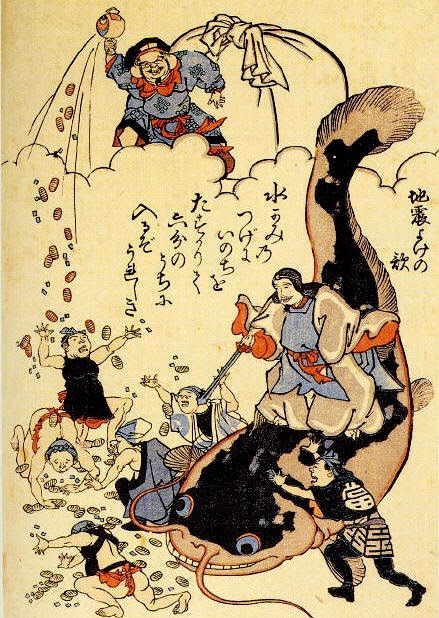
The last great historical moment when these beliefs fuelled popular Utopian expectations on a large scale was probably in the wake of the Ansei Earthquake in 1855. As the historian Gregory Smits points out, the destruction became linked in the popular mind with the arrival of Perry's "black ships" the year before. A large number of woodblock prints (so called namazu-e) exists from these years that depict the gigantic subterranean catfish (namazu) that was thought to cause earthquakes. Many of these prints depict the catfish together with one of the lucky gods, Daikoku, who has a wonderful hammer (uchide no kozuchi) which showers gold over the common people. The message of these woodblock prints was clearly subversive since they called for yonaoshi - "rectification of the world" - which implied the redistribution of wealth. Smits makes a point of the fact that the giant catfish was usually depicted as big and black and that the name Daikoku literally means "big black". In the prints, these two "big blacks" were in turn linked a third, namely Perry's black ships.

Daikoku and the catfish

The catfish forces the rich to throw up their money
Does this rich flora of myths and folklore tell us anything about Godzilla? Well, let us try, as a thought experiment, to map these ideas on film monster and see what we get. I have already suggested that Godzilla can be seen as an incarnation of the trauma of war. Could it also be seen as Ebisu? As a "rare visitor" (marebito) who brings blessings, utopian energies, and the possibility of a renewal or rebirth of the world?

Maybe this is not so farfetched as it may sound. Godzilla, after all, is an ambivalent creature, not so much a mere external enemy to be destroyed as a catalyst of our own inner process of coming to terms with a painful past. In later films, it even takes on the role of defending humanity against other invading monsters, becoming, in effect, a kind of benevolent deity. The sea too was never regarded simply as a bringer of blessings, but was also, just like the monster, a source of destruction, of typhoons and tsunamis. To really grasp the utopian side of Godzilla, however, we need to hold fast to the deep pleasure of destruction itself. This pleasure is well expressed in the following quote:
"Godzilla appeals to that destructive instinct that’s in all kids," says Takeshi Maruyama, a 28-year-old "salaryman," who grew up on the VS series and has an extensive Godzilla figure collection. A lot of buildings were constructed while Maruyama was growing up, a period for Japan’s "bubble era" modernization. And it was a delight to see Godzilla destroy them almost as soon as they went up, Maruyama recalled. One of his favorites is "Godzilla Vs. Mothra," released in 1992, which showed his hometown of Yokohama destroyed, including Land Mark Tower, one of this nation’s tallest buildings, which was being built as the movie was shot. "It is so fun to see a giant thing break and get totally destroyed," he said. "You can’t explain it in words. You just feel it in your heart, and it’s so immediate." (Kageyama 2014)
What is this pleasure? To understand it, we might compare to how the Neo-pop artist Murakami Takashi welcomed the collapse of the "bubble economy" in the early 1990s. Comparing the bubble to a maniacal feeling of having conquered the world, he writes that “when that mirage vanished, we felt relief, as if to say: ‘That’s right, this is what reality looks like’” (Murakami 2005:135). This sentiment was echoed by the philosopher Karatani Kôjin, for whom the collapse was a breath of fresh air. Looking back in 1997, he writes that he had “felt almost suffocated in Japan during the 1980s”, when people were euphoric and Japanese capitalism seemed triumphant (Karatani 1997).

There is, I think, a moral dimension to the pleasure expressed in these quotes, which can be expressed as pleasure at seeing justice done. It is relief at the disappearance of something that is not just suffocating or oppressive, but that by rights should not exist. Here is the place to quote Kafta, who ends one of his stories ("The City Coat of Arms") with the following words: “All legends and songs originating in this city are filled with nostalgia for a prophesied day when the city would be smashed to bits by five blows in rapid succession from a gigantic fist.” Expressed in these words is the pleasure of the apocalypse, of divine force levelling the human world. A similar pleasure is, perhaps, also typical of revolutionary moments. A new world has always required a settling of accounts with the old one. Talk of yonaoshi (rectification of the world) was in fact feared by Tokugawa officials much as the talk of revolution has been feared by elites in the modern world.

Is Godzilla then linked to revolution? Well, it is certainly linked to the desire to erase wrong. The reason that the monster is not simply a fearful external enemy and that there is something pleasurable about the destruction it causes is that the "ghosts" that it embodies are right. The destruction is felt to be rightful and well deserved. As James Berger (1999) points out, the desire for the apocalypse is always a desire for a second catastrophe that will set things right that went wrong during the first one.

The monsters appearing in films like Godzilla and Neon Genesis Evangelion point back to earlier, prior catastrophes that are still not properly acknowledged and atoned for by those responsible for it. The catastrophe of war, perhaps, in which countless people were sacrificed for the nation or the emperor, or the ravaging of nature, or the exploiting of people for the profit of others. These catastrophes have a traumatic quality since the "wrong" that needs to be righted is not just external, but committed by the communities with which "we" identify or the systems that benefit "us". Unlike in the usual enthusiasm for revolution, the trauma calls for the destruction, not of an external enemy, but of ourselves. This is why, at first sight, these monsters appear as vengeful ghosts that won't go away until they are placated, until we apologize properly, until we have found a way to make up for our wrongs. Until that happens, the monsters will reappear and the cities and skyscrapers will continue to be toppled over and destroyed.

Trauma, I suggest, is suppressed revolutionary desire - it is the guise taken by such desire when it cannot be acknowledged by the ego. It is revolutionary in its merciless accusation against the present and in its insistence that justice be done, but at the same time it is suppressed because the ego is unable to acknowledge its own destruction. The trauma calls for the ego to stop identifying with what needs to be destroyed. Freud stresses that the traumatized person actively desires to repeat the trauma. Importantly, this is not just a symptom of the trauma but also part of the process whereby it can be mastered. By repeating it actively, out of its own volition, the ego turns itself from a passive victim into an active agent, and thereby gradually makes the trauma acceptable to consciousness. This can be seen as a process whereby we acknowledge the right of ghosts - as a process whereby we move towards the standpoint of the ghosts and thereby resurrect them, lend them life, as part of ourselves. The working through of a trauma is not a mere inner process, but a transformation whereby we commit ourselves to changing the world into a better one in which the ghosts will not have died in vain. As we repeat, we learn to avoid the "wrongs" of the first catastrophe and, if we learn well enough, not only the ghosts but we ourselves will spring back to life. The pleasure of destruction doesn't just spring from cruelty. Another dimension is the feeling of recovery, or, as Karatani puts it, that we become able to breathe again. 

As I think I've shown, destruction in Godzilla is linked at least indirectly to a form of Utopian imagination. Looking at the list we have assembled so far of the monster's incarnations, we find: the American bombers, the souls of dead Japanese soldiers, the god of the sea, the rare visitor, Ebisu and Daikoku, the giant catfish, and maybe Perry's "black ships". Which one of these incarnations will come to the fore when we watch the movie will depend on our interpretation. When facing Godzilla, we should perhaps ask ourselves, as we should whenever we meet a human being: this person has immense potential both to do me harm and to bring me happiness - what will it be? Will it be both?

The pleasure of destruction


References.

Berger, James (1999) After the End: Representations of Post-Apocalypse, Minneapolis, London: University of Minnesota Press.

Igarashi, Yoshikuni (2000) Bodies of Memory: Narratives of War in Postwar Japanese Culture, 1945-1970, Princeton: Princeton University Press.

Kageyama, Yurika (2014) “Japanese fans speak on evolution of 'Godzilla'”, Japan Today, 28 July 2014; http://www.japantoday.com/category/arts-culture/view/japanese-fans-speak-on-evolution-of-godzilla (accessed 2014-07-28):

Karatani, Kôjin (1997) “Japan is interesting because Japan is not interesting”, lecture delievered in March 1997, reproduced on Karatani Forum: www.karataniforum.org/jlecture.html (accessed on 2002-11-19).

Murakami, Takashi (2005) “Earth in my Window”, pp 98-149, in Murakami Takashi (ed) (2005) Little Boy: The Arts of Japan’s Exploding Subculture, New Haven: Yale University Press

Napier, Susan (1993) “Panic Sites: The Japanese Imagination of Disaster from Godzilla to Akira”, Journal of Japanese Studies 19(2): 327-351.

Smits, Gregory (2006) “Shaking up Japan: Edo Society and the 1855 Catfish Picture Prints”, Journal of Social History 39(4): 1045-1078.

Yanagita, Kunio (1978) Kaijô no michi (The ocean roads), Tokyo: Iwanami.

Saturday, 20 September 2014

Zatôichi, Yôjimbô and imaginations of power

One of the most memorable scenes of Zatôichi (2003, dir. Kitano Takeshi) is near the end, when the blind itinerant masseur Zatôichi (Kitano Takeshi) in a stroke with his sword blinds the "Kuchinawa boss" (Hiura Ben), saying that death is too good for him. The sense of cruel satisfaction here is, I think, a little bit different from the one produced by the typical action movie endings when the bad guys get what they deserve. Here the sense of satisfaction is mixed up, at least to certain extent, with what could perhaps be called the pleasure accompanying intellectual development. Who is the Kuchinawa boss? Is Zatôichi really blind? Questions like these help build up a curiosity in the viewer that is at least as important as the mere satisfaction in seeing justice being meted out. The scene, then, is not simply there to bring closure to the film by distributing justice, but also to reveal new aspects of the story itself.
 
However, what the ending really illuminates is not so much the personalities of Zatôichi and the Kuchinawa boss.  What it brings into view, in a breathtakingly sudden act of illumination, is a particular image of power. Recall that the Kuchinawa boss is a mysterious existence, whose identity is unknown for almost the entire film. Although suspicions soon arise that he might be associated with one of the two rival gangs fighting for supremacy in the little town, he is clearly not identical with the gang's publicly well-known nominal head, Ginzô (played by great actor and rock band bassist Kishibe Ittoku). Ginzô is seemingly victorious after having crushed the rival gang with the help of a newly recruited yôjimbô, the masterless samurai Hattori (Asano Tadanobu). Zatôichi dispatches Hattori, Ginzô and most other gang members in a climactic showdown and then heads into a dark alley to find Kuchinawa. The film now departs markedly from the realism to which it until then had paid half-hearted lip service. In an almost dreamlike sequence he is attacked by ninjas, the leader of whom turns out to be the town's innkeeper (Emoto Akira) who, before being cut down, proudly declares himself to be the Kuchinawa boss. Zatôichi, however, is not fooled. Guided by unfallible intuition, he continues insides the inn where the innkeeper's henpecked underling, an old man with a crooked back, is waiting for him. He is the real Kuchinawa boss, who has now seen his life work being reduced to rubble. "You are the worst of them all", Zatôichi says. A brief exchange of lines follows, before the old man shows his tattoos and definatly asks his antagonist to cut him down - "Kire!". But Zatôichi's sword, quick as a flash, only cuts through his eyes. "Live your life in blindness", Zatôichi says contemptuously - his eyes nailing the old man to the floor, grey as steel and merciless as pistol muzzles - and then he leaves. Meanwhile the villagers are preparing a matsuri (festival). Everything starts anew, the earth is purified and renewed, the house that was burned down by the gang is rebuilt, and all the actors appear on the stage in a joyous step dance, some dressed in jeans and sneakers - as if bidding farewell to the autidence like at the theatre.

Although these final shots break with "realism", they perform a crucial function in visibilizing a form of power that can be characterized as indirect, multilayered and hidden. Zatôichi's journey through the dark alley is metaphorically a journey to the heart of this power, a journey that is necessary in order to cut off the roots of the corruption pervading the visible everyday world of the town (a corruption hinted at in the name Kuchinawa, "rotten rope", with the additional meaning of "snake"). That this journey is necessary explains why the final dénouement must involve an intellectual development. It cannot simply be a showdown with the visible "bad guys" but must also involve a dissection of the interior of the sick body, making this hidden power visible and surgically removing it.

The Zatôichi-character is certainly entirely improbable - a seemingly weak and helpless figure who journeys about as a unfallible, divine justice machine, never losing a duel. Yet he fascinates. Why? At least part of the answer, I believe, is that he embodies the fantasy that a cure to Japan's ills is possible. He is the man who cures Japan of its rotten heart, from the disease that has eaten itself into its soul - from the sense of stagnation and decay that has befallen the "Japanese model" during its recent "lost decades". Seemingly alone in seeing the real culprits behind the decay, his nightly journey to the Kuchinawa boss becomes a journey to the hidden heart of Japan. Guided by supernatural intuition, he becomes the savior of the small, orginary good people while all the experts stand clueless.

This image of Japan as ruled by a power that is hidden and unaccountable is also popular in literature. Turning to Murakami Haruki’s writings, for instance, one finds a vision of the system as an encompassing whole – composed of big companies, shady right-wing organizations and criminal syndicates – in which all opposition is recuperated and co-opted. In A Wild Sheep Chase, "the man in black" describes the shadowy syndicate headed by the right-wing “boss” in the following way:
We built a kingdom…. A powerful underground kingdom. We pulled everything into the picture. Politics, finance, mass communication, the bureaucracy, culture, all sorts of things you would never dream of. We even submitted elements that were hostile to us. From the establishment to the anti-establishment, everything. Very few of them even noticed they had been co-opted. (Murakami 2003:118) 
Matthew Strecher observes that this syndicate – being an organization which “is neither government, business, industry, nor media, yet which somehow holds all of these powers at its disposal” – is “a manifestation of the postmodern State: hidden, elusive, and unaccountable”. It is the very “adversary State against which his [Murakami's] generation battled in the 1960s” which “is now more powerful, and, indeed, more deadly, than ever” (Strecher 1998:358, 361). The picture of society as a total system is perhaps carried farthest in Hardboiled Wonderland and the End of the World, in which Japan is dominated by two giant conglomerates known as the System and the Factory. While battling each other in a war of information, the two conglomerates are also suggested to be “two sides of the same coin” and maybe even run by the same persons (Murakami 1993:299).

Famous kuromaku Tanaka Kakuei
The pervasiveness of this image of power also in Japanese political philosophy is quite striking. Famous intellectuals like Maruyama Masao and Karatani Kôjin, for instance, have repeatedly struggled with how to theorize and critique the particular amorphous form of Japanese power, where the real centers of power are hidden and withdraw from public scrutiny (Here I won't write more about this, but if anyone's interested, please see Cassegard 2007). It goes without saying that this image of power is also closely linked to the way power is actually exercised in many layers of Japanese society - the most well-known example probably being the crucial role played in Japanese politics by kuromaku (lit. "black curtain") - powerful politicians or ex-politicians who act as wirepullers and king-makers behind the scene, often being far more powerful than the serving prime ministers.

Yet this image of power hasn't always been as pervasive as it is today. One way of bringing that out is to compare Zatôichi to an earlier, classic film to which it makes repeated references and of which it might almost be seen as a pastische, namely Kurosawa Akira's 1961 film Yôjimbô. Let me quickly enumerate some of the similarities. The setting is the same: a small rural town in which two rival gangs battle for supremacy and in which the good, small people suffer. In both films, strangers arrive in town that act as catalysts for the mutual destruction of the gangs and the restoration of peace. In both films, a masterless samurai arrives and finds employment as a yôjimbô (bodyguard) in one of the gangs. In both films, a revolver - a sinister piece of Western technology - appears in the final showdown but proves unable to stop the hero. Furthermore, in both films, the inn functions as a form of prototypical "public sphere" where people meet and information is exchanged about the situation in town.

Now for the differences. The most immediately striking difference is that in Zatôichi, it is no longer the masterless samurai who acts as the purifying force, but an itinerant blind masseur (ama). While Hattori is not evil per se, he soon becomes enmeshed in evil and part of the general corruption. Corruption has become much more pervasive. This is evident in the fact that the "public sphere" of the inn too has become corrupt. While the inn functioned as neutral ground and even as a shelter for the yôjimbô of Kurosawa's movie, it is now a place which is run by an innkeeper who reports to the Ginzô gang and who, in the end, turns out to be one of the gang leaders.  

Public sphere?
Instead of the masterless samurai, it is Zatôichi who acts as the cleansing catalyst - a figure belonging to the despised stratum of itinerants, which in premodern Japan also included beggars, lepers, mendicant monks and various kinds of preformers and prostitutes. At the same time, he is equipped with supernatural sword-fighting skills and seemingly also with supernatural intuition. From a realist vantage point, Zatôichi is clearly even more "impossible" than Kurosawa's hero. This "impossible", supernatural quality is underscored by his anachronic chapatsu hairstyle (hair dyed yellow, as among many young Japanese today). The uncanny, crow-like appearance and the equally uncanny ability to find his way - being quite unstoppable, despite his staggering gait - also suggest something almost divine. In terms of folklore, Zatôichi seems to be a form of kami, perhaps of the type Origuchi Shinobu called marebito (divine visitor). Indirectly, he also seems related to other creatures of folklore, such as the tengu - goblins living in the mountains said to possess divine fighting skills.

One of the more useful ideas given to us by Fredric Jamison is, I think, the one that ideology can be understood as the attempt to forge an "impossible", ideal solution to a real contradiction (an idea which, admittedly, ows a lot to Lévi-Strauss as well as the Frankfurt School). One of my friends, Göran Wernström, used this idea in his dissertation in order to argue that Kurosawa's films are animated by an impossible desire to combine socialism with a Confucian respect for hierarchy (Wernström 1996). To solve the contradiction, Kurosawa constantly had to portray "Confucian supermen" - as in Yôjimbô or the Seven Samurai - who through their superior fighting skills help bring about a society in which the small, ordinary people can live in peace but who then have to disappear from that society in which they no longer have a place, and thus "abolish themselves".

Confucian superman?
In Zatôichi, by comparison, there is no longer any hope in the elite, and no room for Confucian hierarchy. Instead, we might say that it is animated by an "impossible" desire to fuse populism (the idea that the "people" is right against the elite or establishment) with a celebration or belief in supernatural powers. The "people" in this case is a people without clear borders except against the elite: it comprises ordinary farmers and townsfolk, but also more marginal elements such as the town's "village idiot", prostitutes and former criminals.

What is problematic here, perhaps, is that this "people" is not really portrayed as capable of helping themselves. Despite the toughness and resolve of the Naruto siblings, for instance, they would have been helpless against the gang without Zatôichi's assistance. While Kurosawa's earlier film offered a kind of role model - a model for the elite, to be sure, but nevertheless a role model that at least some people might strive to emulate - Zatôichi offers little but faith in the possible arrival of the gods. There's little that the small people can do except to wait for the arrival to town of the divine surgeon with his razor-sharp lancet.

In view of the fact that Zatôichi is a film that is usually described as a comedy, that invites lots of laughter and that prominently features lots of beautiful dancing and a matsuri (festival) at the end, it might seem surprising that the film is actually so dark. It's image of society - a nest of corruption that can no longer be cured of its ills through ordinary human powers - is far darker than in the earlier film. This, perhaps, explains the prominent role in it of folklore and religion. In other films too, Beat Takeshi seems to delight in Japanese folklore. Perhaps this is best seen as a religious movie - an apocalyptic, millennarian, religious movie.


References:

Cassegard, Carl (2007) “Exteriority and Transcritique: Karatani Kōjin and the Impact of the 90’s”, Japanese Studies 27(1): 1-18.

Murakami, Haruki (2003) A Wild Sheep Chase (tr. by Alfred Birnbaum), London: Vintage.

Murakami, Haruki (1993) Hardboiled Wonderland and the End of the World (tr. by Alfred Birnbaum), New York: Vintage.

Strecher, Matthew (1998) “Beyond ‘Pure’ Literature: Mimesis, Formula, and the Postmodern in the Fiction of Murakami Haruki”, The Journal of Asian Studies 57(2): 354-378.

Wernström, Göran (1996) Medvetet/omedvetet och filmberättande : en studie i Akira Kurosawas film Sju samurajer, Lund: Lund University.

Monday, 18 August 2014

Is there any nostalgia in The Grand Budapest Hotel?

Although skeptical at first, I was enthralled after a few minutes by the movie I was watching, Wes Anderson's The Budapest Hotel. Not so much by its visual splendour - with the cake-like hotel, the mountains, the stylized miniatures and so on - but rather by the music. The score is by Alexandre Desplat, but some of the best tunes are adaptations of Russian balalaika music (both “Moonlight” and “Kamarinskaya”, performed by the Osipov State Russian Folk Orchestra, irrestibly made me happy). The use of Vivaldi’s Concerto for lute in D Major is also effective.
 

I also liked the skilfull way the characters were introduced and the comical alteration of speaking styles (the “good” protagonists, for instance, like to speak in harangues that sound like when you read poetry aloud). Here the talent of Ralph Fiennes, who plays the consierge Gustave H, is an important contributing factor. I also liked Harvey Keitel’s brief appearance as a tough, matter-of-fact prison inmate (“It’s got what we might call vulnerabilities”). In fact, this is a good movie for admiring the small, brief appearances of several actors.

As an aside, as I write this I realize again that part of the secret of “realism” in portraying people lies in sketchiness, in not revealing too much. During the movie some characters are faced by choices such as: Will Gustave employ the paperless migrant boy? Will the attorney Kovacs cave in to Dmitri’s intimidations? Despite these situations being treated in an offhand way, I found myself watching eagerly to know what choices they would make, since I was unable to predict it in advance. This is of course just like in reality, where we only know most people around us superficially. But it is unlike standard Hollywood movies, where part of the implausability of character portrayals consist in the they are made to fit into pregiven molds and hence become predicatable and knowable at once. To me, this realism was one of the sources of the pleasure of the film.  

So how about serious analysis? Well, it’s a charming aestheticized picaresque. The overt political gestures (the civilized, aesthetic repulsion for fascist barbarism) are commonplace and not much to make a fuss of. So how about the role of nostalgia? Nostalgia is indeed an explicit theme in the film. “There are still glimmers of civilization in this barbaric slaugtherhouse once known as humanity” is a phrase that occurs twice in the movie. Nostalgia is also evoked by the juxtaposition of the hotel as it was at the height of its splendor in the early 30s with how drab it became in the communist post-war period. As the film ends, we are told that it was inspired by Stefan Zweig's The World of Yesterday.

But what is done with this nostalgia? Not much. There is nothing in the film that upsets it or puts it in question (just think of the contrast with The Shining, another great hotel film, where the brilliance of bygone days is an uncanny abode of horror). The Grand Budapest Hotel contrasts the beauty and aristocratic refinement of the lost world of yesterday to the brutality of ascendant fascism – a repulsive enemy that can be rejected without controversy. Admittedly, the fact that Dmitri, the scion of an archduchess, is portrayed as a fascistoid bastard shows an awareness that fascism had historical roots also in aristocratic circles. But such traces of historical accuracy are not developed into a critique and fail to diminish the radiance of the bygone civilization. The same can be said about the fact that the main protagonist is an illegal immigrant boy who has fled a genocidal war. As shown by the behaviour of Gustave, accepting such immigrants with generosity and humanity is portrayed as something that goes hand in hand with the civilization of yesterday. But wasn’t this civilization itself racist and colonialist? It certainly was, but in defense of the movie one might add that it was more so in countries like Britain, France and Germany than in the old Habsburg Empire which seems in fact to have been more tolerant.

So nostalgia is in fact not really a central problem in this movie. It’s there, of course, but not as a problem, not as something it struggles with. Rather than sorrow at the loss of the lovely world of yesterday, the movie delights in its dazzling, fictional reappearance before us. No sorrow can take root in this world since it it constantly swept away by happiness. This delight is akin to that of a collector or connaisseur who finds a lovely piece of art at a flea market or the tourist who discovers a charming little restaurant in a back street. Nostalgia, then, is surface. The film is not at all suffused by any desire to stay in touch with the lost world, a world that is long gone and never really existed anyway - except as a graceful illusion. Near the end, the aged Zero Mustafa is asked by the “author” if he kept the old hotel in order to stay in touch with “his world”, the world of Gustave. No, he replies with a smile, that world was already gone at the time of Gustave, "but he sustained the illusion with marvellous grace”.

Sunday, 6 January 2013

Howl and Alice

Just a brief note on Howl no ugoku shiro (Howl's Moving Castle), which I saw for the first time yesterday as we happened to turn on the TV. There's power in many of the images - the staggering steam-punk castle, the briskly walking palanquin bearers of the Witch of the Waste with their pink costumes...


I may be unfair here, but the story was not as powerful as the images. For a story to work, the images must combine into a credible "world". By credible I don't mean realistic, but something that - as Coleredge put it - invites the willing suspension of disbelief. A credible "world" is one you can dream about after having seen the movie. But I felt this never happened in this film, perhaps because of the many sudden magical transformations.

But transformations in themselves cannot really be the reason. Alice in Wonderland, for examples, is a story full of the weirdest transformations, yet which I still think is enormously successful in creating a "world" which it is possible to dream about, expand in your imagination and use as the setting of your own imagined adventures.
   
What then is the reason for my dissatisfaction with Howl? Perhaps looking closer at the transformations will provide a clue. The deepest impression is created by the film's play with the theme of age - as seen in Sophie's unstable shifts between youth and old age, in the Witch's regression to a harmless old woman, or in Howl to whose childhood world Sophie suddenly gains access through a mysterious door. A double message is delivered up by this play, which seems to say that youth is both important and unimportant. One the one hand, people's age is not important - an old woman can be as charming and lovable as a child or a young girl. But on the other hand, the pure and untainted heart of childhood is the most valuable thing we have, the truly essential thing, a treasure we never ought abandon and which will one day save us.

I can imagine that many viewers of this film associate to Alice in Wonderland. The similarity almost becomes glaring in a scene when the protagonist in her blue dress falls slowly through the air. But the magical transformations the protagonist undergoes in the latter are in body size, not in age, and there is no thematics of salvation in Alice. Howl attempts to build suspension through a thematics of salvation - not in a Christian sense, but in the sense of saving people and the the world from war and magical curses. This salvation comes about through purity of heart. All this is alien to Alice.

Why does the latter work so well as a story despite the many chaotic transformations? Because in Alice chaos is integral to what its main storyline is about. Its main theme is the contest between reason and chaos. Alice's bodily transformations underline the impotence of reason, since she is unable to control even her own body. Reason finds itself constantly frustrated, but the contest is rather friendly. Chaos, reason's "other", is not really terrifying and even reveals itself to be rather delightful. In any case, the transformations are integral to the story's main source of attraction and are not felt to distract from them. The are part of the "world" Alice enters.

In Howl, by contrast, the confrontation is between purity and the curse. There can be no tolerance of the latter, which implies a fearful loss of self. Only purity - the ability to keep one's childhood heart despite all transformations - can conquer the curse. Hence the contest is much more mercyless. The "self" simply must win.

Why do I feel that Alice is so much more free from ideology than Howl?

Friday, 9 September 2011

Parrhesia: notes on the public sphere, power and death

Yesterday I reread Foucault's lectures on parrhesia (collected in Fearless Speech, a booklet published by semiotext(e) which is also available  here under the name "Discourse and Truth"). Rereading them I was struck by the penetrating light they throw on issues such as free speech, public speech and the public sphere in today's world.

Parrhesia means to tell the truth, or literally "to say everything". In particular, it means speaking truth in the face of power, even at the risk of your own life."Someone is said to use parrhesia and merits consideration as a parrhesiastes only if there is a risk or danger for him or her in telling the truth" (Foucault 2001:15f). Parrhesia usually comes from below and is directed to those above. In Hellenistic times the parrhesiastes, or truth-speaker, was  a person who spoke the truth to the sovereign. To be sure, the use of free speech in the agora of Athenian democracy was also referred to as parrhesia, but the imagery informing Foucault's discussion seems Hellenistic rather than Athenian. In any case, the Athenian agora was hardly a space where speeking was without risk. As Arendt states in In The Human Condition, it was a place where "courage and even boldness" was needed for public speech (Arendt 1958:186).

Speaking truth in the face of power – who can help thinking that this sounds so much like Foucault? Especially in its late, Hellenistic version, the parrhesiast is also someone who appears fundamentally alone, left to his own devices in the confines of the sovereign's court and without help from any well-intentioned public sphere prepared to listen to reason.

Using parrhesia as a model for public speech may sound outrageous. Aren't we all today - at least in so-called democracies - free to speak of whatever we like without having to fear reprisals? However, the attitude of speaking truth even when you risk your own life is not so divorced from our understanding of the public and of public speech as we might think at first. One implication of reading parrhesia as a model of public speech is that making something public would be tantamount to declaring: "I know that speaking here might get me killed. Therefore, I speak only because I have already put myself in the position of someone who is dead. I am dead to my status and to the norms and obligations that define my place in society and bind me to it. I therefore speak as a person who has left society, as an outsider, or as a ghost".

The public, I would suggest, arises when we speak from the vantage-point of the dead. We might even go a step further and risk a definition of the place or standpoint from which public speech becomes possible. This space is a liminal space or no-man's-land. We might also call it a sacred space, because sacrality has usually been considered a property of spaces where the voices of the dead can be heard. With Amino Yoshihiko we can say that it is characterized by muen since it is a place in which we must behave as if our relations with the secular world had been severed.

Foucault's parrhesiast par excellence is Socrates. Apart from him, perhaps the court jester is the most famous figure of the parrhesiast in western tradition. In Japan, a similar role was played by children, whose “truths” according to Amino were tolerated since they were considered apart from humanity, sacred or, in a sense, dead. Foucault is quite right in seeing parrhesia as an important line in the genealogy of criticism. In Christianity it is picked up not only in the form of confessions, but also in the idolization of martyrdom. In the self-immolation practices that have become an established protest method all over the world truth is again linked to death or the readiness to die.

Parrhesia? (H. C. Andersen, The Emperor's New Clothes, illustration by A. Rackham)


Just as truth is linked to death, it is also linked to ghosts. In literature, the fear of ghosts often seems to be linked to their ability of speaking the truth. Take the example of the ghosts visiting Richard III in Shakespeare's play: he fears them because they are the only ones who know the truth and can speak it.

In the Japanese Nô dramas, the standard pattern revolves around ghosts who tell the truth and by doing so finally become able to achieve liberation. Typically, a wanderer (the waki) encounters a strange person (the shite) who starts to tell a story about a tragic event ending in death. The shite then changes shape, becoming a terrifying demon who declares himself to be the story's tragic protagonist, now a ghost who is unable to leave earthy existence because of his lingering passions and desire for revenge. The film Seppuku (directed by Kobayashi Masaki, 1962) follows a basically similar pattern. The first half corresponds to the part of the Nô drama in which the background is recapitulated by the shite (here the hero played by Nakadai Tatsuya), who hasn't yet revealed his true nature. Then the crucial unmasking takes place and he transforms himself symbolically into the "ghost" of Motobe who confronts the assembled retainers with the truth, achieving a spectacular and bloody vengeance before finally succumbing to a "second" and final death. The film, by the way, is a masterpiece. The music is wonderful, composed for the biwa (or Japanese lute) by Takemitsu Tôru.

Nakadai Tatsuya in Seppuku (dir. Kobayashi Masaki 1962)
Perhaps it's not so strange that the early medieval "publics" in Japanese history were also places linked to death. The ikki (egalitarian leagues formed for military purposes) were formed by drinking "divine water" symbolizing the cutting of ties to the secular world. The rengakai (poetry gatherings), which were well-known for their egalitarian character, originated in poetry meetings held below blossoming cherry trees (hana no moto renga). Presided over by itinerant priests, these meetings would be attended by commoners as well as warriors or even retired emperors, all hiding or "bracketing" their secular identity behind straw hats or veils. These places, as the historian Matsuoka Shinpei points out, had the quality of muen. Cherry trees were thought to be passage-ways between the living and the dead, or even points of entry to the land of the dead which was thought to be located beneath them. Flower-viewing parties as well as these poetry gatherings in turn went back to the even older tradition of “Yasuraihana”, a celebration involving dancing and playing music that was a call for the flowers to stop falling and at the same time a pacification of dead souls that could bring disease.

To return to public speech, it goes without saying that holding up parrhesia as a model of public speech carries with it the risk of idealization. Foucault points out that, early on in Greek thought, doubts appeared concerning the negative aspects of parrhesia - is everybody entitled to use it, or should it be limited to people of a certain quality or education; and how about the possibility of parrhesiasts being mistaken about the truth (Foucault 2001:72)? Furthermore, parrhesia also poses the problem, from the parrhesiast's own point of view, of its limited efficacy. No matter how much the parrhesiast might hope that "dying" to the material circumstances that tie him or her down to a particular place in society will enable the voice to travel freely and reach the ears of everybody, in real life that voice may well be smothered. Nothing says that people will listen even if the parrhesiast forfeits his or her life. If you want a public, it’s not enough with courage and free speech. There must be people who can hear you, and who are willing to listen. And you must be willing to listen to them.

Using Habermas' expression, we could say that there can be no public speech without a public sphere. Still, Foucault does elucidate a fundamental dimension of that public sphere, namely the operation of bracketing. To participate in the public sphere you need to bracket your everyday dependencies, power-relations and status in real life. This is an aspect stressed by many of the theorists of the public sphere or public realm. Habermas points out how important it was for the formation of the early bourgeois public sphere that discussions could be conducted in the coffeehouses and salons without regard for rank or status. Arendt too stresses that bracketing, or "play-acting" is necessary in public in order to create arenas where all participants can participate as peers of equals. Speaking about the Greek isonomy (equality), she writes:
Isonomy guaranteed... equality, but not because all men were born or created equal, but, on the contrary, because men were by nature... not equal, and needed an artificial institution, the polis, which... would make them equal. Equality existed only in this specifically political realm, where men met one another as citizens and not as private persons. (Arendt 1977:21)
Bracketing is of course only a temporary operation. Once deliberation is over, the game of tolerance will end. What Foucault adds to the discussion of bracketing is again related to death and risk-taking: remember that when you leave the agora, you are back in the web of dependencies again, and then you might have to run for your life!  
For unlike isonomia (the equality of all citizens in front of the law) and isegoria (the legal right given to everyone to speak his or her own opinion), parrhesia was not clearly defined in institutional terms. There was no law, for example, protecting the parrhesiastes from potential retaliation or punishment for what he or she said. (Foucault 2001:72)
A striking image of the risks awaiting the parrhesiast once he or she has stopped speaking might be found in Zhang Yimou's film Hero (2002). This is a film that revolves around the dialogue between the emperor Shi Huang-di and the would-be assasin in which truth is finally disclosed. This dialogue, which takes place in the dark and totally empty courtroom of the emperor, can be seen as a compressed public sphere à deux in which deliberation drives the narrative forwards towards a gradual revelation of truth. Like all public spheres, it has the semblance of peace. Speech rather than violence becomes the centre of action, a fact epitomized by the assasin's decision not to kill the emperor. As he finally leaves the courtroom and descends the gigantic stairs down to the palace gate, he is outside the sacred circle of speech and ready to be sacrificed. The film ends with his death as he is nailed to the closed palace gate by a rain of arrows. What was bracketed is un-bracketed.

Public sphere (Hero, dir. Zhang Yimou, 2002)
That unbracketing must take place once speech is over has, of course, not been ignored in liberal political thought. Already Kant made the distinction between public speech, where one was free to make public use of one's reason, and activities in mundane life outside the public, where one had to "obey". What was needed to protect the speaker and facilitate the use of public speech was thus, firstly, the establishment of a "civil" public culture in which words would not be met by violence, and, secondly, to find institutional mechanisms for counteracting the unequal distribution of power (through checks and balances, procedures for anonymous voting, and so on). Already Athenian democracy came up with ways to prevent the centralization of power, such as lottery and anonymous voting (ostracism), that protected citizens from the danger of having to expose themselves publicly.

What distinguishes Foucault from liberal political thinking is his reluctance to rely on either on the presumed civility of modern publics or on institutionalized mechanisms for counteracting power. Like the parrhesiast, he clings to the "truth" carried forward by the word, by public criticism, even as he sees through the power relations operating through the public. His stance is therefore characterized by a very curious ambivalence in regard to public speech, which is on the one hand the carrier of explosive "truths", but on the other hand lacks the medium that would be required for these truths to be transmitted properly, namely a well-functioning public sphere. Lacking a medium in which truth can survive in disembodied form, it must take refuge in the body of the person who knows the truth. Parrhesia remains relevant to us today, because - as Foucault points out - that truth insists on being spoken, even at the cost of putting the body at risk. A paradoxical result of truth's embodiment is that the (potentially) dead body also becomes the logical position from which truth must be uttered.

Of course, I am not claiming that Foucault is trying to apply the idea of parrhesia directly to today's situation. What he claims is merely that it forms an important part of the roots of the "critical" tradition in Western philosophy - a tradition to which Foucault can surely be counted:

And I would say that the problematization of truth which characterizes both the end of Presocratic philosophy and the beginning of the kind of philosophy which is still ours today, this problematization of truth has two sides, two major aspects. One side is concerned with insuring that the process of reasoning is correct in determining whether a statement is true (or concern itself with our ability to gain access to the truth). And the other side is concerned with the question: what is the importance for the individual and for the society of telling the truth, of knowing the truth, of having people who tell the truth, as well as knowing how to recognize them. With that side which is concerned with determining how to insure that a statement is true we have the roots of the great tradition in Western philosophy which I would like to call the "analytics of truth". And on the other side, concerned with the question of the importance of telling the truth, knowing who is able to tell the truth, and knowing why we should tell the truth, we have the roots of what we could call the "critical" tradition in the West. And here you will recognize one of my targets in this seminar, namely, to construct a genealogy of the critical attitude in the Western philosophy.
In addition, nothing stops us from trying to recognize parrhesia as a theme of continued centrality even in today's world. The best and most liberating kind of protest often has the quality of parrhesia. We find it in the gays or lesbians who decide to come out in public. We find it in social movements, especially in their early stages when people decide that they must speak up. We find it in writers and intellectuals too, at least in those who are ready to face unemployment and risk their social standing. We find it in Mrs Poyser, when she finally decides she's had enough and, after years of humiliation, erupts in protest and gives her landlord a piece of her mind (see the lovely description in Scott 1990:6ff). The public of such courageous, decent people is also a liminal space, a space in which they have no longer anything on which to rely but themselves.

Walter Benjamin describes how, in moments of revolutionary upheaval, the dead will come to join the struggle. No wonder, once you stop trying to survive, you can speak freely. Your companions are now the dead, the comrades of the past who have returned to join you again to help you build a better future.


References

Arendt, Hannah (1958) The Human Condition, Chicago & London: The University of Chicago Press.

Arendt, Hannah (1973) On Revolution, London: Faber and faber.

Foucault, Michel (2001) Fearless Speech, ed. Joseph Pearson, Los Angeles: semiotext(e).

Matsuoka, Shinpei (2004) Utage no shintai – Basara kara Zeami e (The Body of the Banquet: From Basara to Zeami), Iwanami shoten.

Scott, James (1990) Domination and the Arts of Resistance, New Haven & London: Yale University Press.

Thursday, 8 April 2010

S/N

Last week I saw went to see a film recordning of S/N, dumb type's celebrated theatrical dance performance from 1995.

It's about AIDS, but also about much more. Watching it I increasingly felt that it was also about the sediments of my self, poisoned with gender, nationality and power.

It opens up with darkness. There are figures running and falling, electronic sounds that are sometimes painful. A swirl of circle shaped images of naked torsos in a cold, inhuman blue light - all round, as if put in the line of fire or seen in a microscope.

Dance, music, images, text drill themselves into your eyes, ears and mind.
The beauty of pain.
No, this is no whole, no damned, smooth, claustrophobic Gesamtkunstwerk.
It never makes you impatient, since it opens up and tears away.
Who could fail to love anything that chills your heart like this?
It is montage at its best. It is so good.

There is a montage-like effect in the juxtaposition of actors too: in the movement between Furuhashi's acerbic, unsettling intensity and Bubu's gentle patience.

Much of the force of the performance comes from  genre-montage, as when Furuhashi in drag bursts out in "People who need people". Just as love can no longer be thought without AIDS, songs that would have been boring in themselves are suddenly good, rescued by their insertion into a montage, as if only sarcasm could make them sound just so sweet, innocent and moving as they probably aimed to be when they were created.

No doubt it's copyright problems concerning som stupid quoted chanson that's prevented the S/N DVD from being released.

If irony and desperacy are the only ways to save sweetness from being ideological, then why am I then suddenly so moved by totally un-ironical words like these: "Don’t cry, you’ve finally made a step in the right direction”?

S/N hits you underground, it digs open these hardened layers of self (so poisoned with prejudice), and makes you long for change.