Showing posts with label Quote of the month. Show all posts

Thursday, 13 October 2016

The poet laureate of rock n' roll

We live in a fallen world. That's a sentence that makes sense even if you're not religious. Religious language is sometimes needed to express truth, even if truth is not what religion says it is. Few people have expressed this particular way of apprehending the world as well as Bob Dylan. Here are some of his most pregnant and memorable formulations:
I hear the ancient footsteps...
Sometimes I turn, there’s someone there.
Other times it’s only me.

The cards are no good that you’re holding, unless they’re from another world.
There’s no exit in any direction, ’cept the one you can’t see with your eyes.
One of the things that make Dylan an unforgettable experience is his meanness, his roughness or toughness, which is also a loneliness - the loneliness of a person trying to live in a fallen world without being swept away by depravity, without following others, without asking anyone else's opinion. This is also meanness towards oneself, an impatience with admirers, with recognition and with honors. His skill in giving voice to this meanness in his text is enough to make him one of the greatest poets I know. Here are a few more sentences, which I'll leave as they are, without context. Some are from his songs, others from interviews. They seem to work well that way, conveying the loneliness of their author, standing on their own, without help from others.
All the truth in the world adds up to one big lie. 
I think that this world is just a passing through place and that the dead have eyes and that even the unborn can see and I don’t care who knows it.

You always got to be prepared, but you never know for what.

Be kind because everyone you’ll ever meet is fighting a hard battle.
One more thing before I end. Many people seem to think he shouldn't have been awarded the Nobel Prize. Maybe they're right. But not because he doesn't deserve it. What would he do with the prize? He probably won't appreciate it. He'll always respect "the hearts and the hands of the men who come with the dust and are gone with the wind" far more than he respects the Swedish Academy. But even without the prize, he would be a hero of literature. He connects up with the roots of literature. If we think Francois Villon is a great poet, Dylan should be thought of as one as well.


Tuesday, 6 September 2016

Gripping or feeling? (Quote of the month)

This one's an old classic - the final line of Baudelaire's The Stranger:
- Well then! What do you love, unfathomable stranger? 
- I love the clouds… the passing clouds … up there … up there … the marvelous clouds!
I recalled these lines this morning as I went to work. Or rather: I thought of the balance between grasping and letting go. I thought of the ambivalence of the hand, which is both sensory organ and grapple. Imagine a man, a sensitive person who wishes in secret for his hands to be transformed into feelers. A man who wishes that he could spend his life without ever having to grasp or hold on to anything. Would such a man be possible? The wish, at any rate, would be possible. It's there in Baudelaire's "stranger". In the flâneur, content to move through the swarming city that abounds in dreams, savouring the spectacle of things he will never be part of. This man never clutches. He never grabs hold of things. He lacks the desire to possess, and he never says: "this belongs to my life, without it I cannot live!". It's easy to despise such a man, I suppose, but at the same time there's something angelic about him.


Sunday, 15 May 2016

Quote of the month: Hemingway (and Murakami)

"Man is not made for defeat." This sentence - part of Santiago's train of thoughts near the end of The Old Man and the Sea (p. 80) - is a sentence that breathes both tiredness and a kind of stoicism. Man is not made for defeat, but he is defeated. Defeat is unavoidable if one lives long enough. Needless to say, "man" here is also woman.

I'm not sure Hemingway ever learned to accept defeat. Santiago is not defeated. He has his dignity, and nothing to be ashamed of, because he knows he has done well. And think of sentences like "Every thing is your own damned fault if you're any good" (from Green Hills of Africa, p. 202). These aren't things you say when you're defeated.

Let me follow up this by turning to Murakami Haruki, who writes in one of his short stories: "As Ernest Hemingway realized, the value of our lives is ultimately determined by how we lose, not by how we win" ("Kaeru-kun, Tokyo o sukuu", from Kami no kodomotachi wa mina odoru, p. 180). This sentence hangs together with and speaks to another of the short stories in the same collection ("Thailand"), where a woman, Satsuki, takes a vacation after a conference and receives a helpful piece of advice by her driver Nimit:
"You're a beautiful person. A doctor. Intelligent and strong. But you look as if you're dragging your heart behind you. The time has come for you to start preparing for the slow descent towards death. If, from now on, you devote all your power to living, you won't be able to die well. Little by little, you have to shift. To live and to die are in a sense equivalent, doctor!"
    "Nimit", Satsuki said while removing her sunglasses, leaning forward from the backrest.
    "What is it, doctor?"
    "Have you been able to prepare yourself to die well?"
    "I am already half dead, doctor", Nimit said as if stating something self-evident. (Murakami 2000:142)
That night Satsuki cries in her hotel bed. Her driver's words have helped her come alive again, because she too had in a sense been dead, in the sense of having lived for years suppressing her emotions and cutting herself off from her inner self. Paradoxically, he helped her release these emotions by urging her to prepare to die. There's something Heideggerian about his advice, and yet one doesn't have to be a follower of his philosophy to accept that Nimit might have a point. No-one lives for ever, just as economic growth or human civilization cannot last for ever. All things that have form must vanish. It is not to any authentic resolution he urges her to gradually turn, so much as towards a slow acceptance of death that also unhinges us from desire and hatred, and that ultimately implies a liberation from karma. It is a death that unchains us from everything we have told ourselves must be our fate. Maybe it's comparable to the "dropping off of body and mind" that Dôgen speaks off, a state where you are free to accept death since you are already dead. Or maybe it is more instructive to compare it to the ideal of the sufi: "to become a 'dead man walking': one whose body stays alive on the earth yet whose soul is already in Heaven” (Chatwin 1988: 179).

The idea about a mid-point in life where you need to start preparing yourself for death appeals quite strongly to me. The other day when I went to work, I thought about how long I had been able to tell myself that I had a future. For most of my life I've been a believer in my bright future. A future that was pleasantly blurry and appeared almost limitless. But now, I told myself as I walked, I'm already here, in the midst of this future. I liked those words and repeated them: I'm in the midst of my future. Yes, here I am, in the midst of this strange country: the future. The contours are clearer now. This is how it looks. The future too has a future, but it is shorter.
   
I was feeling tired. That might have been one reason for my ruminations. Defeat always seems near to a person who's tired. Tiredness is a good emotion. It makes you remember important things. It's also an emotion that often appears in Hemingway's novels. Here's a sentence from one of them, a good one that is full of tiredness, and that I agree with despite my tiredness:

“The world is a fine place, and worth fighting for.” (For Whom the Bell Tolls, p. 499)


References

Chatwin, Bruce (1988) The Songlines, London: Penguin.

Hemingway, Ernest (1994) For Whom the Bell Tolls, London: Arrow Books.

- (1994) Green Hills of Africa, London: Arrow Books.

- (2004) The Old Man and the Sea, London: Arrow Books.

Murakami, Haruki (2002) Kami no ko wa minna odoru, Tokyo: Shinchō bunko

Sunday, 17 April 2016

Quote of the month: Julius Caesar

If I would tell you, dear reader, that the quote of the month will be "veni, vidi, vici", I'm sure you'll react with exasperation. Isn't it the very epitome of a worn-out cliché? It certainly is. In addition, it's almost unbearably theatrical. But let me just ask you a single question: why the "vidi"? Why did Caesar stress that he "saw"?

Let me offer you one more quotation. Here is Caesar again, describing his victory in a sea battle over the Veneti:
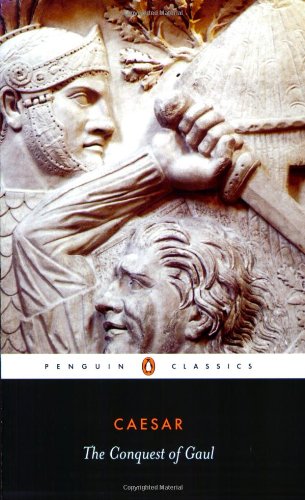
After that it was a soldier's battle, in which the Romans easily proved superior, especially as it was fought under the eyes of Caesar and the whole army, so that any act of special bravery was bound to be noticed... (The Conquest of Gaul, Penguin, 1982: 80)
Similar passages stressing the inspiring effect that Caesar's gaze has on his troops abound in The Conquest of Gaul. Just to take one more example, here he describes how he manages to turn around a difficult situation during the battle against the Nervii simply by showing that he's looking at his soldiers: "His coming gave gave them fresh heart and hope; each man wanted to do his best under the eyes of his commander-in-chief, however desperate the peril" (ibid. 69).

We can also note that the ability to "see" can be delegated to commanders lower in rank. In one passage he recounts a speech that Labienus, one of his generals, held to his troops before a battle: "Fight as bravely under me as you often have under the commander-in-chief; imagine that he is here, watching the battle in person" (ibid. 137).

Passages like these show Caesar's awareness of the importance of his gaze. But why is the gaze important? Here it is easy to recall the so-called Hawthorne effect. It's well-known that this effect was discovered in the course of a series of observations conducted at a factory where the researchers experimented with changing one condition after the other (lengthening and shorting working hours, increasing and decreasing the number of breaks, increasing and decreasing pay etc) to see what the effect on worker productivity would be. To their consternation they discovered that productivity increased no matter what changes they introduced. The solution to the riddle, they realized, was that the productivity increase was an effect of being observed. It was the workers' response to the presence of the researchers and the attention the latters paid to them. As the sociologist Johan Asplund points out (in his book Det sociala livets elemäntära former), the workers were simply following their human nature in being socially responsive. It's simply natural to humans to respond to the presence of others and their actions. The inspiring and energizing effect that Caesar's gaze had on his soldiers seems to be of exactly the same kind as the effect that the gaze of the researchers had on the factory workers.

What Caesar directs our attention to is, furthermore, the relation between seeing and ruling. In the many passages where he emphasizes the importance of seeing, he seems, implicitly, to be saying that a central functions of the sovereign (or a place-holder of the sovereign, such as a general) is to be the one who sees. Why is this a central function of the sovereign? This, it seems to me, is related to the fact that the sovereign must also be the one of upholds and guarantees the "public" or "official" side of society. To impersonate the sovereign is to be the one who, by seeing, is capable of endowing an act with official recognition and making it public, thereby rescuing it from oblivion. Again and again, in passage after passage, Caesar rehearses this role. Being seen by Caesar, the act is lifted up from the anonymity of merely private existence and granted a kind of immortality. Why immortality? Since the sovereign, as Kantorowicz points out, has "two bodies" - one that human and mortal and another that is divine and immortal. Here we shouldn't let the language of the "sovereign" in singular mislead us. Even in democratic states lacking individual rulers, the "place" of the sovereign exists, as Lefort points out. Wherever we find anyone trying to monopolize the function of being the one who sees, we are witnessing someone aspiring to fill this empty place.


Saturday, 27 February 2016

Quote of the month: Musil

I will try to post, once a month, a quote from my recent reading that I find to be interesting or delightful in some sense. Each quote will be accompanied by a brief, unambitious comment where I try to explain what struck me about it.

My first quote is from an essay by Robert Musil:
I recall a saying of Goethe’s that made an odd impression on me some years ago. It runs: one can only write about those questions one does not know too much about. (Robert Musil, Precision and Soul, The University of Chicago Press, 1990:31)
This seems psychologically true. My first thought on reading it was that it would be an excellent motto for my blog. I've always thought that a blog should be a place where people are free to write in an unpretentious fashion about anything without having mastered the subject. At the same time, a blog should help thought onwards, towards a state of better knowledge. Lukács once described the mood of the essay as longing for an idea not yet born. The same, in my view, can be said of the blog.

What is amazing about good blog texts and essays is that they seem to move with a precision that stems from their fidelity to the movement of thought itself. This precision can make these forms very satisfying intellectually, despite the unpretentious nature of the genre. The reason for this, I feel, is that these forms seem to imply, as a sort of convention of the genre, a recognition of the latter's limitations. To write an essay or blog is to admit that you lack knowledge, and that gives these genres an air of intellectual honesty that is missing in more pretentious genres, such as treatises, reports or academic articles.

My second thought was indeed that the quote also illustrates very well why so much academic writing feels false or irritatingly superficial - especially today when academics are rewarded more for their amount of publishing than anything else. A rather strong argument could be made, I think, to the effect that academic writing per se privileges superficiality. To a great extent this is a consequence of the reliance of academic disciplines on specific sets of methods. Method, I once wrote, is a tool for blinding oneself to relevant information. Although that may have been an exaggeration, I still think that one of the primary functions of method is to sort away information and relieve researchers from having to take the complexity of real, concrete situations into consideration. Method, to put it in a nutshell, is a tool for liberating researchers from the kind of knowledge that would be an obstacle for their writing.

Essays are method-less writing. To the extent that researchers need to "publish or perish" and to the extent that publishing requires them to adhere to certain specified methods, this leads to an exclusion not only of certain forms of knowledge, but also of researchers interested in pursuing such forms of knowledge, and of genres - such as the essay - suitable for such pursuit.

My third thought was perhaps not so much a thought as a kind of mental note of the delightful cascade of questions which the quote triggered in me. Would it be possible to generalize Goethe's statement somehow? Might one, for instance, say that whatever is written is unfinished? Would the statement also hold for other activities? Is it also impossible to speak or think about things one knows too well?

These questions, needless to say, can only be dealt with if I first clarify why the statement seems to ring true. The answer that I find most convincing is that writing is never just a way to approach truth, but also at the same time an act that distances you from it. Say that you jot down a sentence, trying to capture the essence of a thing. Even if the sentence elucides part of the truth, it simultaneously sidelines or excludes other aspects of it. Reluctance to engage in such exclusion seems to be the reason why familiarity with a subject can be an obstacle for writing. Since you don't want to shunt aside anything that is essential - part of the truth - writing in effect becomes impossible.

The most common way to avoid this problem is undoubtedly to keep one's knowledge superficial, for instance by relying on methods.

But aren't there ways to write while doing justice to truth? For instance, how about if we shift from a monological to a dialogical concept of truth? The problem concerning the inability of writing to capture or transmit knowledge seems to arise above all when the writer is a single person trying to present a coherent account from a single perspective, in a single 'voice' so to speak. With Bakthin we might suggest that the form of the novel - especially in its most developed 'dialogical' or polyvocal form, as seen in Dostoevsky - is one possible solution to the problem.

But is it possible to introduce dialogical forms in other genres than the novel? It seems to me that this is a question addressed by both Benjamin and Adorno, even though they don't use the word dialogical.

Adorno, for instance, explicitly rejects the attempt to capture a subject through a single voice or perspective. It requires a plurality of mutually incompatible vantagepoints which come together in a "constellation" of concepts that, rather than attempting to subsume the subject, circle around it, unlocking it through a combination rather than through a single key. A similar idea can be found in Benjamin, who likens such constellations to spider webs for capturing ideas.

How should one end an essay or a blog-post? Can they ever be ended? Almost by definition they preclude conclusions. Perhaps the best way to end them is by returning to the beginning.